Best of 2022
Best of 2021
Best of 2020
Best of 2019
Best of 2017-2018

1291 Conrad Road, Lewisville, Forsyth County
Hilltops, the Conrad Family Farm
- Sold for $865,000 on December 29, 2023
- The deed shows the sale was for 13.17 acres, described as “The Homestead on Conrad Estates.”
- The original price was $2.395 million for “over 50 acres.”
- 3 bedrooms, 3 bathrooms, 2,856 square feet
- Price/square foot: $303
- Built in 1858
- Listed April 11, 2023
- Last sale: $5.475 million (339 acres)
- Note: County records show the house sitting on an 81-acre tract.
- The house was built by either John Joseph Conrad (1805-1871) or his son Augustine Eugene Conrad (1828-1917). A.E. owned it when he died. He had served as chairman of the county Board of Commissioners for may years. “Mr. Conrad was one of the most prominent and widely known men in that section of the state,” The Charlotte Observer noted in reporting his death.
- His estate sold it to William Joseph Conrad (1856-1941), one of his four surviving children. A.E. had six children by two wives over a period of 41 years. The house and much of the Conrad property remained in the Conrad family until 2022.
- Dr. William J. Conrad was memorialized as the “dean of N.C. dentists” by the Winston-Salem Journal. He was a graduate of the Kernersville Institute, Emory & Henry and the Pennsylvania Dental College, class of 1876. He practiced until 1934, retiring at age 78.
- He was a charter member of the Winston-Salem YMCA. He also was a member of the board of deacons at First Baptist Church for 50 years and superintendent of the Sunday school for 25 years. William died at Hilltops at age 85.
- The current owners began selling off large tracts for development as soon as they bought the 365-acre Conrad property, now entirely on the Forsyth County side of the nearby Yadkin River. The Conrad family had 2,000 acres at one point, some of it, including the family cemetery, across the river in Yadkin County.
- Sixty acres adjacent to 1291 Conrad Road was sold on a 50-50 basis to a Maine firm in the waste management and remediation business and a Georgia mental health clinic. Another 120 acres went to a local developer that originally planned a high-density residential development. Opposition from neighbors led to a revised plan for 15 high-end homes ($750,000 and up) and 42 mid-range houses ($350,000 to $500,000).
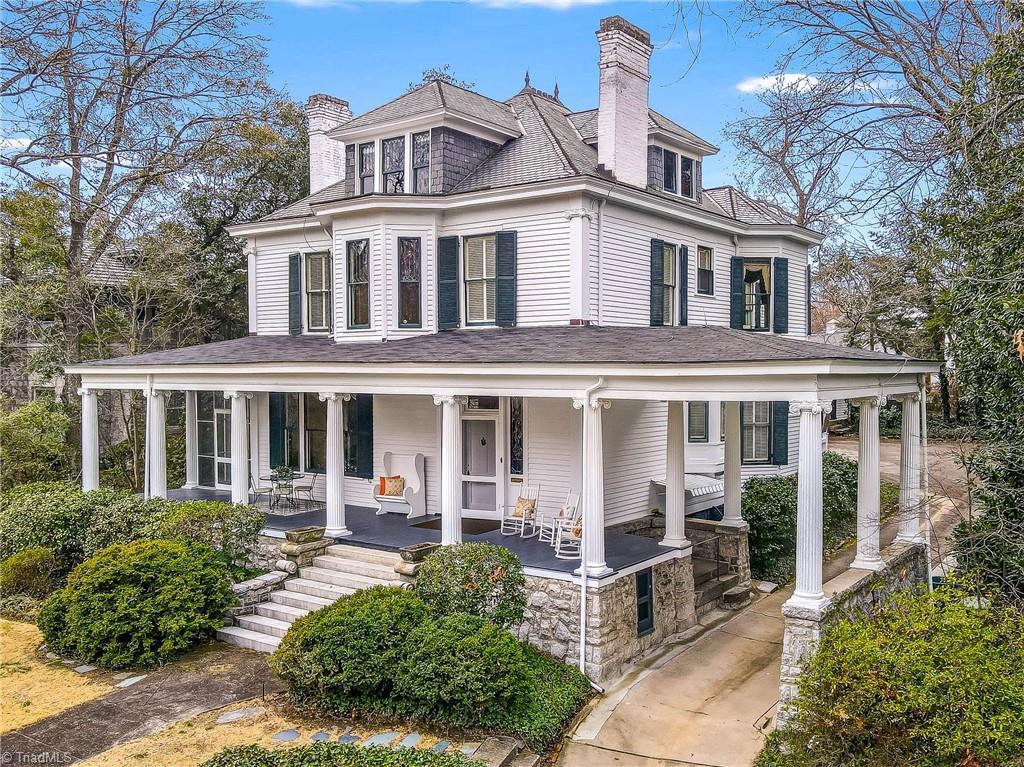
- Sold for $805,000, December 13, 2023 (originally $1.295 million)
- 4 bedrooms, 2 1/2 bathrooms, 3,568 square feet, 0.53 acre
- Price/square foot: $226
- Built in 1907
- Listed February 23, 2023
- Last sale: $160,000, January 1984
- Neighborhood: Fisher Park historic District (local and NR)
- Note: Designated as a Guilford County landmark
- The house has had only three owners
- Designed by architect Richard Gambier, Mount Airy granite stonework by the locally prominent Andrew Schlosser.
- “The two-story frame house features a Mount Airy Granite foundation with grapevine mortar, and includes a broad porch of Ionic columns that engaged a porte-cochere. A high, hipped roofline is pierced by hipped dormer windows and tall corbelled chimneys. Key features of the interior include sidelights and a transom of beveled leaded glass, [and] a bay window….” (Preservation Greensboro)
- District NR nomination: “Queen Anne/Col Rev. Large boxy hip-roofed house w/projecting bays; fluted Corinthian columns at porch that wraps around to porte cochere; Corinthian capitals at cornerboard.”
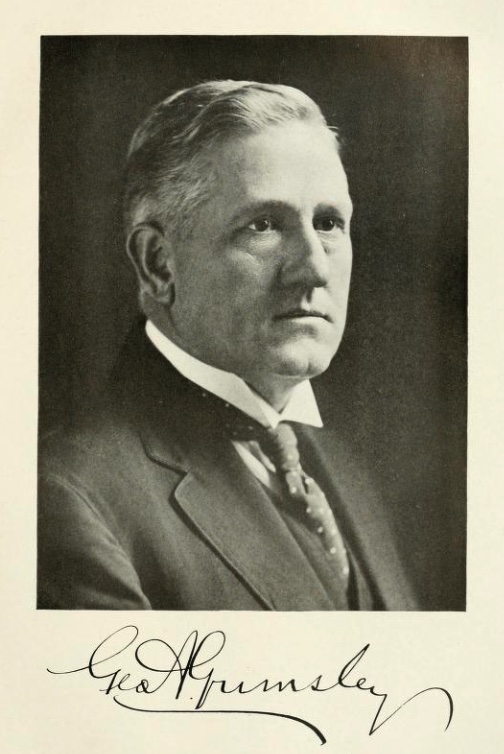
- The original owners were George Adonijah Grimsley (1862-1935) and Cynthia Dunn Tull Grimsley (1858-1947). Few people associated with Greensboro have had a greater impact on the city and North Carolina than Grimsley.
- The son of a farmer, Grimsley was a native of Greene County. He graduated from Peabody Normal College in Nashville, Tennessee (now Vanderbilt University’s college of education). At age 20, he established Tarboro’s first graded school and served as its superintendent.
- Eight years later, in 1890, Grimsley was hired as superintendent of Greensboro’s two public schools. He proposed that governance of school be moved from the city aldermen to a school board, which was created in 1893. His ideas on teaching students “to think and to give expression to their thoughts, and at the same time giving them a taste of the best literature” brought wide recognition. In 1899, the school system established its first high school, now named for Grimsley.
- Grimsley’s emphasis on literature led him to believe in the necessity of libraries in both schools and communities. In 1897 Grimsley and colleagues drafted a bill for state Sen. Alfred Moore Scales to introduce allowing for the establishment and funding of public libraries in the state (one of his partners in the effort was Annie Petty, the first trained librarian in the state). The bill was passed, and the Greensboro Public Library opened in 1902 with 1,490 books bought with funds raised by school children and their parents. “Many of them denied themselves candy and gum and contributed their pin money to the library,” Grimsley said of his students.
- Grimsley was also a big believer in insurance. In 1901, while still superintendent of schools, he organized Security Life and Annuity Company. He left the school system in 1902 and worked full time in insurance. Five years later, he helped create the Jefferson Standard Life Insurance Company in Raleigh. Security Life and Jefferson Standard merged in 1912, keeping the latter’s name and headquarters. A year later the firm moved to Greensboro and named Grimsley president. He held the position until 1919, when he left to establish a new company, Security Life and Trust. That company, too, was a success.
- Insurance broker Fielding Lewis Fry (1892-1961) and Fanny Williams Fry (1895-1983) bought the house in 1937 and owned it until 1984. Fielding served as mayor of Greensboro, 1947 to 1949. He was also chairman of Brookgreen Gardens in Murrell’s Inlet, S.C., the first public sculpture garden in America and “the floral jewel of South Carolina’s coast.”
- The house was bought in 1984 by hotel executive Alan F. Strong and Prudence Fraley Strong (1938-2020). Prudence was from Statesville and graduated from Duke University. She originally was a high school teacher and later worked as a real estate agent.
.

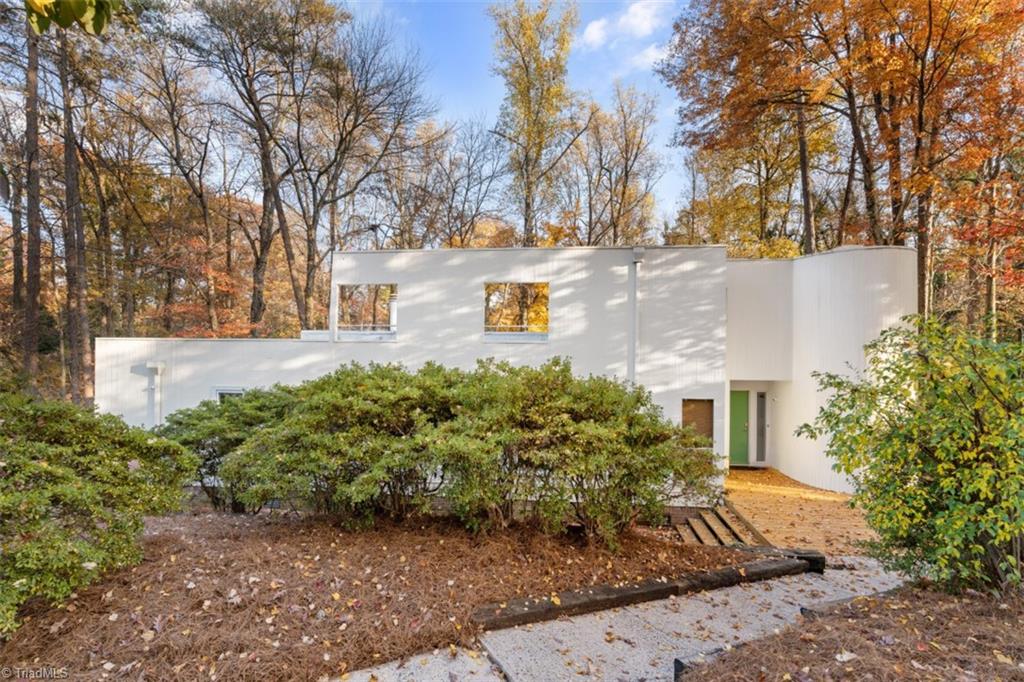

2520 Aaron Lane, Winston-Salem
The Donald and Nancy Wolfe House
- Sold for $625,000 on December 1, 2023 (listed at $585,000)
- 4 bedrooms, 3 1/2 bathrooms, 2,945 square feet, 0.55 acre
- Price/square foot: $212
- Built in 1976
- Listed November 17, 2023
- Last sale: $223,500, May 1995
- Neighborhood: Woodberry Forest
- Note: The house was designed by Wesley McClure of the McClure Design Group of Raleigh.
- The original owners were Donald Howard Wolfe (1934-2019) and Nancy B. Wolfe, who owned the house from 1976 to 1995. As a faculty member of Wake Forest’s theatre department, Donald directed more than 30 plays from 1968 to 2000. He served as president of the Southeastern Theatre Association and the North Carolina Theatre Association, was active in the Little Theatre in Winston-Salem and was a supporter of the North Carolina Black Repertory Company and the International Black Theatre Festival, which honored him with its Lifetime Achievement Award.
- The Wolfes sold the house to its current owner in 1995.
.


109 E. Haywood Lane, Mount Gilead, Montgomery County
The Harris-Caffey House
- Sold for $440,000 on November 16, 2023 (listed at $439,000)
- 4 bedrooms, 4 1/2 bathrooms, 4,034 square feet, 0.54 acre
- Price/square foot: $109
- Built in 1898
- Listed September 25, 2023
- Last sale: $35,000, September 2000
- Note: “A 2013 addition houses a lovely large family room and a second floor ensuite.”
- The property includes a gazebo and a fountain, both in the front yard; a two-car garage; and a small storage building.
- The house is the only residence among 10 structures listed among the “cultural resources” in the town’s comprehensive plan (p. 12).
- State Historic Preservation Office: “2-story side gable frame Queen Anne house w/twin front gables & hip roof front porch”
- From Mount Gilead Pride: “Masten Leak Harris (1858-1912) was born in Harrisville (near Pekin). He was married to Annie R. Bruton, with whom he had six children. ‘Miss Annie’ was described as a tall, stately, handsome woman. She loved her church and was a faithful member, teaching a class of boys in Sunday School and enjoying her work in the Missionary Society.
- “M.L. Harris was connected for many years with the Mount Gilead Store Company [also here], of which L.P. Byrd was president. All of the family were members of the Mount Gilead Methodist Church. Theirs was a home filled with love, music, and laughter.
- “Daughter Jennie was a graduate of the Southern Conservatory of Music in Durham, and taught piano for many years in Mount Gilead. She was also the church organist for some time.
- “On September 20, 1912, she was married to Henry Braxton Ingram at the Harris home. It was her parents’ 25th Anniversary. A month later in October of 1912, M.L. Harris died of cancer. He and his wife are buried in the Harris plot at Sharon Cemetery.
- “This was written about him in the local newspaper, The Mount Gilead Southerner, following his death:
- “‘He was a man of Christian character. He had many friends in the community as he was a man of unswerving integrity, and always worked for the good of the town and community. He was an earnest advocate of better schools, better churches, and better citizenship. In his death, the town and community is deprived of one of its best and most useful citizens.’
- “In 1920, the Harris house was sold to James Francis (Jim) Caffey (1887-1960). Mr. Caffey was born on a farm in Stokes County. In the early 1900s, he ‘went west’ to Arkansas and Oklahoma to work in the lumber industry. After a few years, homesick for family and N.C., he returned to work with Nissen Wagon Co. of Winston-Salem.
- “He was sent to Montgomery County, where hardwood was abundant, to secure lumber for the manufacture of wagons. There, he met and married Susan Virginia Haywood, daughter of Preston Syrus Haywood.
- “In the 1920’s working for Mount Gilead Cotton Oil Co., he was made Mill Manager. In 1923 he was named Superintendent of the company. He later became the first person help run the operation of United Mills when it was organized. He worked there until 1952, when he was 75 years old.
- “He died in 1960, and his casket was placed in the front parlor of the house for an old-fashioned, Southern-style wake. Many mourners, both black and white, visited the home to pay their respects to ‘Mr. Jim.’”

100 Fisher Park Circle, Greensboro
The William and Jessie Hewitt House
- Sold for $1 million on November 13, 2023 (originally $1.595 million)
- 5 bedrooms, 3 1/2 bathrooms, 6,855 square feet, 0.42 acre
- Price/square foot: $146
- Built in 1918
- Listed April 18, 2023
- Last sale: $549,500, April 2002
- Neighborhood: Fisher Park Historic District (local and NR)
- Note: The property includes a guest house.
- District NR nomination: “Three Fisher Park Historic District dwellings display the two-story columns and porticos synonymous with the Neoclassical Revival … Bank president W.A. Hewitt’s house, built between 1920 and 1925 at 100 Fisher Park Circle, at the edge of the park and North Elm Street, is a large, two-and-a-half-story frame structure with a swan’s neck entry surmounted by a Palladian window, side wings with columned sun porches, and a two-story pedimented portico of attenuated columns.”
- A two-story, attenuated Doric portico overlooks the park and shades the symmetrical five-bay front facade of this large gable-end structure. A swan’s neck entry at the center of the front facade stands below a Palladian window. The rear facade is marked by a projecting round bay. The side wings have columned sun porches.
- William A. Hewitt (1873-1939) and Jessie Scott Hewitt (1883-1950) were living in the house by 1915. William was the owner of Greensboro Supply Company, a machinery dealer, and later served as president of the local Morris Plan Bank. In 1920 he was president of the Rotary Club; Fisher Park neighbor Julian Price was vice president.
- After Jessie’s death in 1950, Dr. Hugh Melvin Hunsucker (1916-1989) bought the house. He divided it into six apartments and an office for his orthodontics practice (he lived in Starmount Forest).
- After his death in 1989, the house was kicked around from one owner to another three times before the current owner bought it in 2002 and returned it to a single-family residence. The restoration of the house received an award from Preservation Greensboro in 2003.

4118 Oak Ridge Road, Summerfield, Guilford County
The Alexander Strong Martin House
- Sold for $85,000 on October 30, 2023 (listed at $110,000)
- bedrooms, bathrooms, 2,694 square feet, 0.66 acre
- Price/square foot: $32
- Built circa 1835
- Last sale: $90,000, December 2015
- Neighborhood: Summerfield Historic District (NRHP)
- Note: The house is owned by the Town of Summerfield. Preservation North Carolina is selling the house for the town.
- Preservation North Carolina: “The Alexander Strong Martin House has benefited from recent foundation repair and removal of non-historic additions. The property has a septic system, but no well. The house will require a complete rehabilitation including all mechanical systems (electrical, plumbing, and HVAC), some restoration carpentry, a new kitchen and bathrooms. The staircase maintains its original unique carved tapered newel posts and handrail, but is missing its straight picket balusters that will need to be restored. The existing septic should be tested for operability. The Alexander Strong Martin House is eligible for historic tax credits.”
- “The Alexander Strong Martin House is an early, modestly rendered example of the Greek Revival style featuring solid brick construction and finely crafted details such as a corbelled brick cornice; decorative curved exposed rafters; a 60-inch wide, double-leaf glazed front door set within deep coffered panels; an elaborate transom above the main entrance door; and well-executed, mitered window surrounds. The additional six-panel door to the left of the main entrance provides access to a room once used as an office. The front porch with a flashy center gable was added later and is composed of Tuscan colonettes atop brick piers, while the back porch displays a more Victorian-inspired version with turned posts, fretwork, decorative brackets and a shingled center gable.
- “The interior of this 8-room house is equally modest yet finely crafted with a variety of styles perhaps reflecting its use over the years as a single-family home, home office, fabric shop, and apartments. The main entrance opens into a broad center hall with the staircase located on the left and a Victorian door with stained glass in the rear hall opening onto the back porch. The main parlor features an 8-panel door with decorative woodgraining and a high-style Victorian mantle. The opposite front parlor features a 2-panel Greek Revival door also with woodgrain paint and boxlock. The other seven mantles are much simpler. Plaster walls, wide tongue-and-groove ceiling boards, wood floors, symmetrical door and window molding with cornerblocks, and 6-panel doors are found throughout the house.”
- “The Alexander Strong Martin House is an early, modestly rendered example of the Greek Revival style featuring solid brick construction and finely crafted details such as a corbelled brick cornice; decorative curved exposed rafters; a 60-inch wide, double-leaf glazed front door set within deep coffered panels; an elaborate transom above the main entrance door; and well-executed, mitered window surrounds. The additional six-panel door to the left of the main entrance provides access to a room once used as an office. The front porch with a flashy center gable was added later and is composed of Tuscan colonettes atop brick piers, while the back porch displays a more Victorian-inspired version with turned posts, fretwork, decorative brackets and a shingled center gable.
- District NRHP nomination: “This two-story, five-bay, double-pile, side-gable Greek Revival-style house is built of American bond (1:3) brick with corbelling on both exterior end chimneys and at the cornice. A pressed-metal roof covers the main section of the house. Both the front and rear of the house have a full-width, asphalt-shingled, hipped-roofed porch. Craftsman details prevail on the front porch with slender Tuscan columns on brick piers and the siding in the central gable that exhibits an Oriental influence. The rear porch has Queen Anne-style details … with turned posts, carved brackets and shingle siding in the center gable. Windows are six-over-six.”
- Alexander Strong Martin was the son of Alexander Martin (1740-1807), a merchant, lawyer and one of the most prominent figures of North Carolina’s Revolutionary Era. The elder Martin was an a native of New Jersey and an early graduate of Princeton. Through a brother in Virginia, he also was a friend of James Madison Sr. and helped convince him to send his son and namesake, the future president, to Princeton rather than William & Mary. From the 1770s into the 19th Century, Martin served as speaker of the N.C. Senate, governor (elected four times), U.S. Senator and many other public positions. Martin never married but acknowledged Alexander Strong as his son. The child’s mother was Elizabeth Lewis Strong (b. 1753). Her husband, Thomas Strong, had disappeared during the Revolutionary War
- The house was built around 1837 by Valentine Allen. He and his brother James had bought 872 acres in the area from the estate of Charles Bruce, one of the earliest settlers in the area, originally called Bruce’s Crossroad. Alexander Strong Martin (1787-1864) bought the house and 448 acres in 1838. He owned it for 11 years. (This information is from an article in the Northwest Observer, which contains some conspicuous inaccuracies — the house itself is not listed on the National Register, and Gov. Martin was not the first governor of North Carolina — but it’s the only readily available source for the early history of the house.)
- More photos

1100 Reatkin Lane, Swepsonville, Alamance County
The Quackenbush House
- Sold for $475,000 on September 28, 2023 (listed at $489,000)
- 4 bedrooms, 2 1/2 bathrooms, 3,180 square feet, 1.47 acres
- Price/square foot: $149
- Built in 1850
- Listed August 17, 2023
- Last sale: Land, March 1950, price not recorded on deed; house, mid-1990s, price and exact date unknown (see note).
- Architectural Inventory of Alamance County: “This house is a two-story, Italianate I-house with a ‘Triple-A’ roof line. Relatively unaltered, the house is three-bay wide, single-pile with a one-story rear-ell.
- “The house has a full-height projecting center front gable bay, paired by drop pendant brackets at the eaves, returns in the gable ends large six-over-six windows [now, regrettably, one-over-one replacements] with unusual curved surrounds and a hip roof porch carried by pairs and triples of chamfered posts on brick plinths.
- “The long rear ell may have been an earlier c. 1850 Italianate dwelling, remodeled and joined to the later Italianate house.”
- The Architectural Inventory states that “the house was owned by the Quackenbush family from before the Civil War up until the 1990s.” Ownership can be traced online back to David Vance Quackenbush (1886-1962) and Lelia Ruth Dark Quackenbush (1888-1986). David was the proprietor of Graham Lumber Company.
- Census records indicate he was born in Chatham County, where his father apparently lived his entire life, so he didn’t inherit or buy the house from his father, William Jacob Quackenbush. Deeds show David buying three properties from a possible relative, W.B. Quackenbush, in 1916 and 1918 (as well as at least 15 properties from other owners around the same time). Identifying the exact locations is essentially impossible because the deeds’ obsolete descriptions of the properties reference adjoining property owners and long-gone stones and other markers rather than street names and addresses. The county’s online database of deeds doesn’t appear to document ownership of the house (or any other property in Alamance) by members of the Quackenbush family in the 19th century.
- The home’s original address was 1205 S. Main Street in Graham. “In October 1996 it was moved 3 1/2 miles to its current location, just off N.C. 54 north of the village of Swepsonville,” the Architectural Inventory says. That survey gives the original location as “on West Moore Street,” but a 1994 document from the State Historic Preservation Office shows it as 1205 S. Main, now the location of South Graham Medical Center. That letter references an upcoming road project, the construction of which may have prompted the moving of the house two years later.
- The buyers of the house in 1996 presumably were Jerry Mack Cox (1944-2015) and Susan Coble Cox, who owned the property at 1100 Reatkin Lane to which the house was moved. Jerry’s parents, Kindred Mack Cox (1908-1984) and Clara Bivins Cox (1913-1993), had bought the land in 1950, and it has remained in the family ever since.
- The 1994 letter asserts the opinion of the State Historical Preservation Office that the house was eligible for the National Register (it most likely wouldn’t be eligible now because it has been moved). That view wasn’t shared by the Federal Highway Administration, which, presumably, was keen to see the house torn down. The preservation office did note that the house had undergone significant changes, including the loss of two interior chimneys and the replacement of the front porch.
- The document also includes the self-contradictory statement that, as of 1994, the house retained both “its original wood siding” and the “highly unusual — one-of-a-kind in Alamance County — curved window surrounds.” If the house had wood siding, how could the brick window surrounds been visible? And if the siding was original, why would those surrounds even have been created, only to be immediately covered?
- The house, though, did have wood siding at some point. The Architectural Inventory, published in 2014, has an undated photo that shows the house with wood siding, painted white.

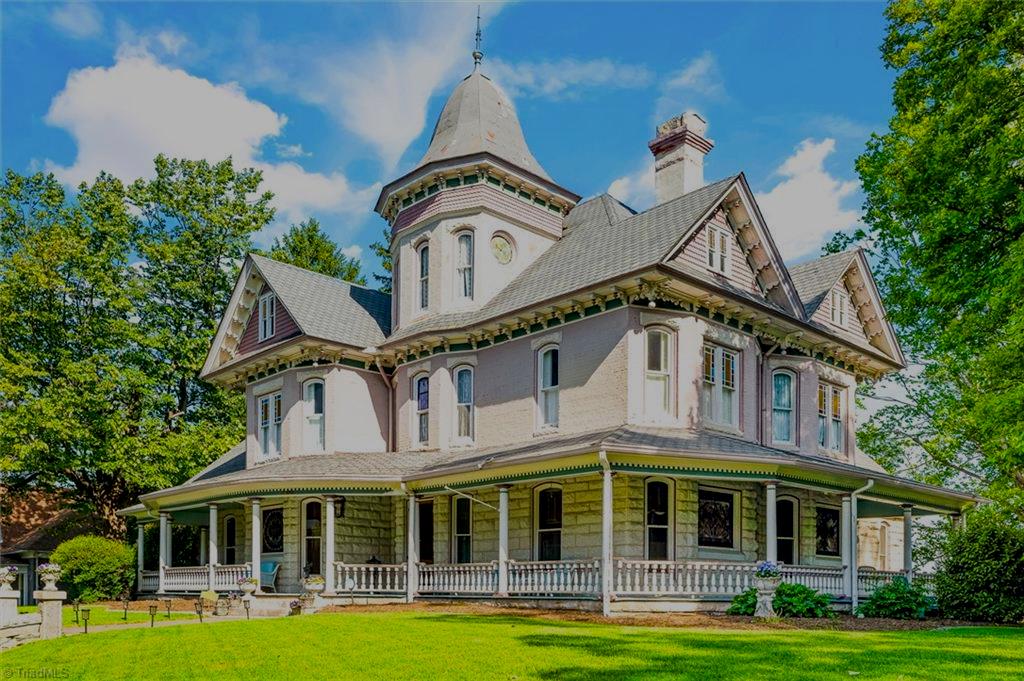
400 W. Pine Street, Mount Airy, Surry County
The James A. Hadley House
Blog post — A Mayor’s Monumental 1894 Queen Anne in Mount Airy, $675,000
- Sold for $615,000 on September 14, 2023 (listed at $675,000)
- 4 bedrooms, 3 bathrooms, 4,581 square feet, 0.77 acre
- Price/square foot: $134
- Built in 1894
- Listed June 17, 2023
- Last sale: $94,500, June 1991
- Neighborhood: Mount Airy Historic District (NR)
- Note: The listing says the house was “the first in Mount Airy to be built with Granite which was sourced directly from the site.”
- Historic district NR nomination: “The Queen Anne style was popular at the turn of the century, and outstanding examples of the nationally popular style are located throughout the district. The finest of these is the James A. Hadley House at 400 West Pine Street. Hadley was a tobacco industrialist, real estate developer and mayor of Mount Airy. His magnificent house reflected his prominent position in the community.
- “A large two-story structure, the house displays a wealth of Queen Anne characteristics. It is composed of a rich variety of materials, details and forms. The foundation, first story, and window sills and lintels are of granite, the second story and three-story bell-cast roof central tower are brick, the gables are sheathed in decorative wood shingles, and fancy wood brackets support the eaves.
- “Many of the windows boast colorful stained glass, while the main entrance features elaborate etched glass designs. Multiple projecting bays are outlined by an elaborate wrap-around porch.
- “The interior of the house is equally well-detailed with fine woodwork, elaborate plaster ceiling medallions, and original lighting fixtures.”
- “Magnificent Queen Anne style mansion, built between 1894 and 1900 by James Alfred Hadley [1853-1916], co-owner of the Hadley-Smith Tobacco Factory, real estate developer, and several-term mayor of Mount Airy.
- “One of the finest Queen Anne style houses in Surry County, its first story is rusticated granite, second story is brick with granite trim, and has a three-story central tower with bell-cast roof and finial.
- “The house also features wood shingled gables, bracketed eaves, abundant stained glass (four panels were stolen in the early 1980s and replaced by local artisan, Ed Atkins), a broad wrap-around porch with Doric columns and dentilled frieze, segmental and flat arch granite-trimmed windows (most one-over-one and some colorful multi-pane), tall corbelled chimneys, standing seam metal roof, double-leaf carved oak main entrance doors with etched glass, and granite retaining wall marking the large lot.
- “On the interior are handsome, robust staircases, paneled wainscot, ornate mantels with mirrored overmantels, plaster ceiling medallions, original lighting fixtures, and a pair of marble columns between the foyer and hallway.”
- Hadley was Mr. Everything in Mount Airy. The 1913 city directory identifies him modestly as a “manufacturer,” but also lists him as vice president of the Bank of Mount Airy and a member of the local Highway Commission, the school board and the Water and Light Commission. The directory no longer listed the Hadley-Smith company, which may have been bought out by R.J. Reynolds, which did have a factory in the city by then.
- Swannanoa Brower Hadley (1864-1973), James’s wife, continued to live in the house after his death at age 63. She outlived him by a prodigious 57 years, never remarrying and living to the age of 109. She also outlived three of their five children. The house was sold in 1975 by their two surviving daughters, Sallie Hadley Yokley (1891-1980) and Lucy Hadley Cash (1893-1994), both widows themselves by then.
- The address was listed as 221 Pine Street in the 1913 city directory, the earliest available online.

1090 Dalton Place Drive, Dalton, Stokes County
The Matthew Dalton Phillips House
- Sold for $400,000 on September 5, 2023 (listed at $400,000)
- 4 bedrooms, 2 bathrooms, 3,024 square feet, 4.81 acres
- Price/square foot: $132
- Built in 1888
- Listed July 7, 2023
- Last sale: The property may have been in the Philips family since the house was built.
- Listing: “A 36 by 20 foot two story structure which used to be the Dalton Store is also on the property. This building is standing but is in disrepair and is not safe to enter.”
- The house has a Pinnacle mailing address. It’s about 2 1/2 miles southeast of the town.
- The original owners may have been Dr. Matthew Dalton Phillips (1851-1925) and Margaret Melissa Dalton Phillips (1862-1947).
- Matthew was a native of Stokes County and graduate of Wake Forest College, class of 1871. He studied medicine at Jefferson Medical College in Philadelphia and New York University. Returning to Stokes County, “he practiced scientific medicine for forty years,” according to an entertaining entry on the WFU website. He was still practicing when he died of pneumonia at age 74.
- “The family believes he caught a chill from crossing a stream in wintry weather while making his regular rounds. Once asked why he continued to practice medicine in the tiny village of Dalton, Phillips replied, ‘I am needed here.’”
- Matthew and his older brother John Yewell Phillips (1846-1919) were classmates at Wake Forest. The university says John was the last ex-Confederate soldier to graduate from the college. He became a lawyer and state legislator.
- Margaret’s father, David Nicholas Dalton (1826-1895), came to the town of Little Yadkin in Stokes County from neighboring Rockingham County. It was halfway between Salem and Mount Airy. He built a tobacco factory and owned more than 2,000 acres at one point. The town was renamed Dalton’s Depot when the Cape Fear & Yadkin railroad came through, later shortened to Dalton. (Source)
307sunset

307 Sunset Drive, Greensboro
The Williamson-Weill House
- Sold for $2.5 million on August 29, 2023 (listed at $2.75 million)
- 6 bedrooms, 4 1/2 bathrooms, 4,259 square feet, 1.02 acres
- Price/square foot: $587
- Built in 1924
- Listed November 16, 2022
- Last sale: $1.1 million, March 2022
- Neighborhood: Irving Park Historic District (NR)
- District NR nomination: “Prominent Greensboro architect Charles C. Hartmann designed this handsome Colonial Revival dwelling for Lynn B. and Eleanor Williamson. The grounds were planned by Pennsylvania landscape architect Thomas Meehan.
- “The house is a two-story brick dwelling with a slate-sheathed gable roof and an array of classical details, including pedimented dormers, trigylphs on the cornice frieze, a central entrance with columns and a swan’s neck pediment, and a Palladian window surmounting the entrance. A one-story sun room with balustraded roof deck extends from the west side of the house, while a two-story wing extends from the east side.”
- Note: Charles Hartmann (1889-1977) was one of Greensboro’s most distinguished architects of the period. Among his works are the Jefferson-Standard Building in downtown Greensboro and Julian Price’s Hillside mansion in Fisher Park.
- The current owners have restored the home. Their previous restorations include Hillside.
- The original owners were textile executive Lynn Banks Williamson (1872-1940) and Eleanor Virginia Farish Williamson (1975-1962). They were first listed at the address in 1925, the year they moved to Greensboro from Burlington. Lynn had been president of E.M. Holt Plaid Mills in Burlington. At the time of his death, he was a director of Burlington Mills and president of Virginia Mills in Swepsonville.
- After Lynn’s death, daughter Eleanor Williamson Ward (1909-1986) and son-in-law Nathaniel M. Ward (1906-1980) moved from his hometown of Baltimore to live in the house. They sold it in 1973.
- From 1973 to 2020, the house belonged to C.L. “Buddy” Weill Jr. (1924-2020) and Dorothy Siegmund Weill (1929-2016). Buddy Weill was one of Greensboro’s most prominent businessmen for decades. After serving in the Army in World War II, he became president of his father’s insurance firm, Robbins & Weill, and established Weill Investment Company. He was one of the organizers of Well-Spring Retirement Community, where he was living when he died at age 95.
- Buddy served on and/or led a remarkable number of the city’s high-profile boards, including the Center for Creative Leadership, Greater Greensboro Realtors Association, Greensboro College, Greensboro County Club, Greensboro Planning and Zoning Commission, Greensboro Symphony, Lineberger Cancer Center at UNC-Chapel Hill, Moses H. Cone Memorial Hospital, United Way of Greater Greensboro and the UNC Greensboro Excellence Foundation.

848 W. 5th Street, Winston-Salem
The Rosenbacher House
- Sold for $1.1 million on August 21, 2023
- 5 bedrooms, 2 1/2 bathrooms, 4,968 square feet, 0.50 acre
- Price/square foot: $221
- Built in 1912
- Last sale: $225,000, January 2014
- Neighborhood: West End Historic District (local and NR)
- Note: Now occupied by a health spa and a cafe. It was the site of Michael’s on 5th, a locally prominent restaurant, for more than 20 years beginning in the mid-1980s.
- The seller was a construction company that restored the house and used it as their office.
- District NR nomination: “[T]he Rosenbacher House is one of the grandest of the Neo-Classical Revival dwellings in Winston-Salem and is one of only several examples of the style in the West End. ”
- “The large two-story weatherboarded house is dominated by a monumental two-story central portico with Corinthian columns and a full pedimented entablature. Enhancing the Classical design of the facade are one-story curved porches with Ionic columns, turned balustrades, and modillioned cornices which run from the portico to the front corners of the house. At second story height, a modillioned cornice encircles the house beneath the truncated hip roof,
- “The fenestration of the house is exceptional, with the central entrance boasting double-leaf doors and leaded and beveled glass sidelights and fanlight transom, and the large front and side windows of the first story having beautiful round and segmental-arched leaded glass transoms.
- “The interior of the house is as exceptional as the exterior. The large front hall is separated from the rear stair hall by a grandiose Ionic arcade, and segmental-arched sliding pocket doors serve as openings between the major rooms. The stair is an ornate Colonial Revival one which rises in a transverse manner.
- “One of the most impressive rooms in the house is the dining room, characterized by a handsome Colonial Revival paneled mantel and overmantel, a high paneled wainscot topped by a plate rail, a boxed beam ceiling, and what appear to be original wallpaper borders. At the rear of the house is a large double room divided by an Ionic archway.
- “In 1909 Mrs. Carrie Rosenbacher, widow of Sigmund Rosenbacher, purchased the western half of Mrs. Jennie D. Kerner’s lot, and the following year she and Alladin, Fannie, Otto, and Sandel Rosenbacher were listed at this location in the city directory. The Rosenbachers were associated with Rosenbacher & Brothers, a successful clothing store in Winston. By 1946 only Sandel Rosenbacher was living in the house, but the family retained ownership until 1975.”

411 S. Main Street, Old Salem, Winston-Salem
The Charles A. Cooper House
- Sold for $810,000 on August 14, 2023 (originally $1,050,000)
- 4 bedrooms, 5 1/2 bathrooms, 3,900 square feet
- Price/square foot: $208
- Built in 2006
- Listed September 20, 2021
- Last sale: $38,000, December 2001 (land only)
- Listing: “Based on old photography, partially excavated foundation, and tons of research and experience, the home has been reconstructed to its original 1840’s appearance by historic home builder Steven Cole.”
- The house features reclaimed doors and iron work from the 1700’s, full mortise and peg windows made of heartpine wood and wavy glass, imported European bricks to line the fireplaces, and wide board white oak flooring on three of the four levels.
- County records show the square footage as 2,628, which looks way too small.

2314 Asbury Road, Asbury, Stokes County
The Smith Simmons House
- Sold for $580,000 on August 14, 2023 (originally $659,900, later as low as $575,000)
- 4 bedrooms, 3 bathrooms, 2,918 square feet (per county), 1 acre
- Price/square foot: $199
- Built in 1891
- Listed April 11, 2022
- Last sale: $34,000, November 2016
- Note: The listing says it’s a wedding and event venue, but its website appears to be offline (info here).
- The listing shows 4,492 square feet, a discrepancy of 54 percent.
- The house has a Mount Airy mailing address, although it’s near the Asbury community in Stokes County, 12 miles northeast of Mount Airy.
- Listing: “Some of the furnishings are also available for sale.”
- The property includes a barn and a “pub,” originally the free-standing kitchen.
.

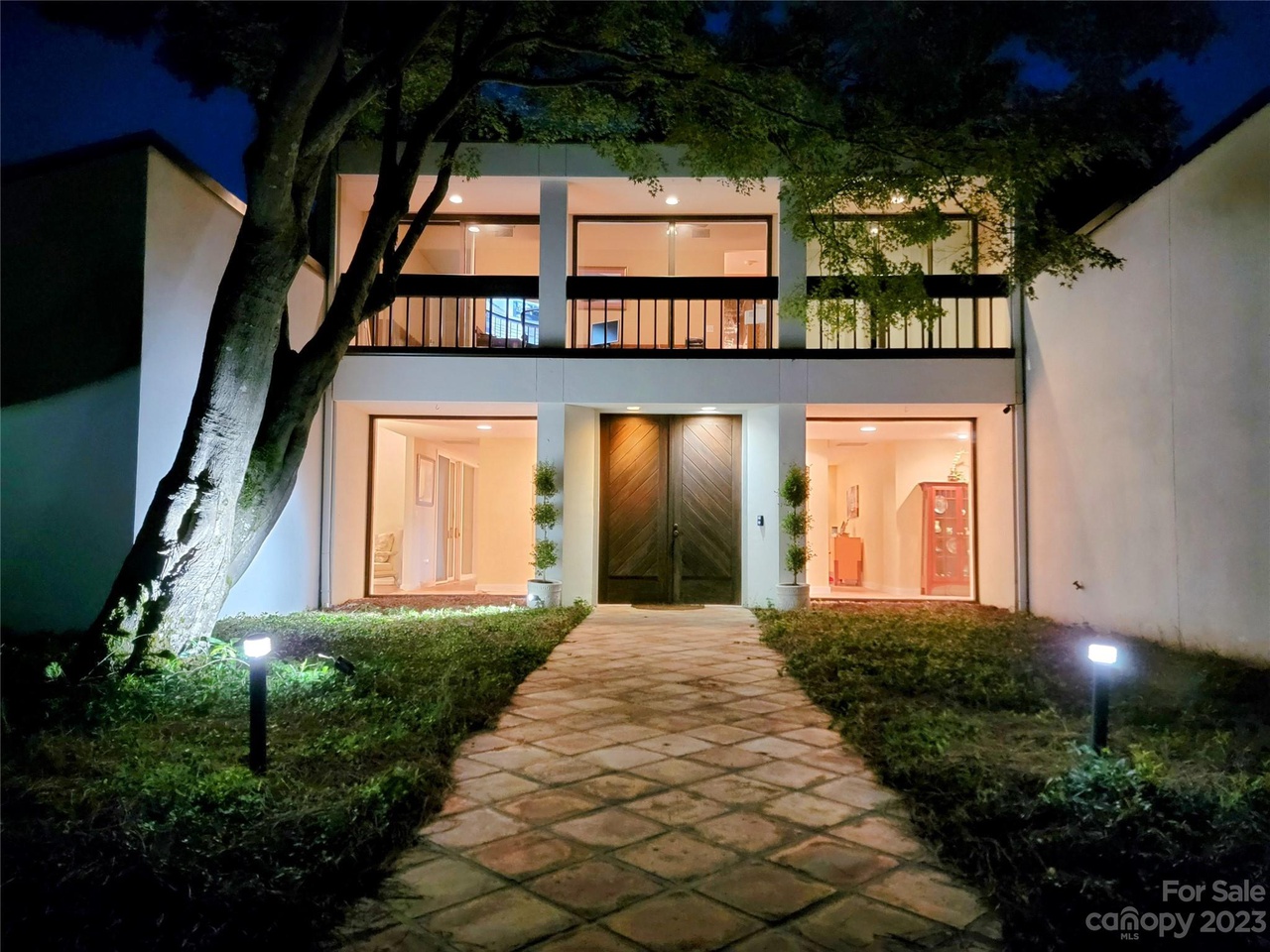

482 Biscoe Road, Troy, Montgomery County
The Charles and Dorothea Russell House
- Sold for $1.075 million on August 10, 2023 (originally listed at $1.095 million)
- 5 bedrooms, 5 bathrooms, 5,588 square feet, 23.47 acres
- Price/square foot: $192
- Built in 1974
- Listed July 13, 2023
- Last sale: $605,000, March 2016
- Sales hype: “An exquisite architectural gem … a dream come true for those seeking both opulence and tranquility”
- Note: Designed by renowned modernist architect Thomas Hayes. Landscape design by Lewis Clarke.
- The property includes a vineyard, barn, solar energy installation near the barn and 2,400 square-foot swimming pool.
- County property records show 9 bedrooms and 5 1/2 bathrooms.
- The property consists of two adjacent lots, split by the city-county line. The lot with the house (15.2 acres) is in the city of Troy; the other (8.27 acres) is in the county.

2450 Glencoe Street, Glencoe Mill Village, Alamance County
- Sold for $315,000 on August 10, 2023 (originally $250,000)
- 2 bedrooms, 2 1/2 bathrooms, 1,744 square feet (per county), 0.24 acre
- Price/square foot: $181
- Built in 1885
- Listed: March 9, 2021
- Last sale: $250,000, March 5, 2019
- Neighborhood: Glencoe Mill Village Historic District (local and NR)
- Note: The listing shows 1,809 square feet.
- The house was sold on March 5, 2021; listed for sale again March 9, 2021; and withdrawn two weeks later.
- District NR nomination: “The Glencoe Historic District is located on the east bank of Haw River about three miles north of Burlington in Alamance County. It is a typical but remarkably well-preserved example of nineteenth century industrial villages that once flourished in North Carolina’s Piedmont region. …
- “The predominant house type was originally a four room, two-story structure typical of North Carolina rural housing of the late nineteenth and early twentieth centuries. The front porches are two bays wide and supported by four unornamented posts. A central hallway open onto rooms to the east and west. The western rooms of houses on these two streets do not have windows on the river (west) side. Chimneys are set on the east. Upstairs there are usually two rooms, with the railing from the narrow staircase extending into the west room. …
- “A later modification of the mill housing is the kitchen, attached at the back of the east wing of most houses, forming an L. These rooms had, by 1910, largely replaced the detached kitchens, of which only a handful remain. The connected kitchens have chimneys and customarily have side porches facing the river and the mill (west).”
.


326 E. Main Street, Troy, Montgomery County
The Robert Terrell Poole House
- Sold for $310,000 on July 20, 2023 (listed at $389,000)
- 4 bedrooms, 3 bathrooms, 3,159 square feet, 0.94 acre
- Price/square foot: $98
- Built in 1905
- Listed April 5, 2023
- Last sale: $95,000, April 2019
- Listing: “After 4 years of renovations, this 1905 Queen Anne with all the signature gingerbread, fancy fretwork, working transoms, original hardware has been brought back to life.”
- The home’s sale in 2019 was its first since it was built.
- The 2019 listing said the original gingerbread, fretwork, transoms and hardware on doors and windows were intact and that the interior featured a cantilevered staircase, decorative wooden ceilings and a lion head/lion paw mantle.
- Robert Terrell Poole (1875-1940) was a lawyer and state legislator. He lived his entire life in Montgomery County. He served two terms in the state House. His wife, Bess Pulliam Poole (1884-1964) gave the house to two of their daughters in 1951. In 2019, the daughters’ heirs sold the house for restoration.
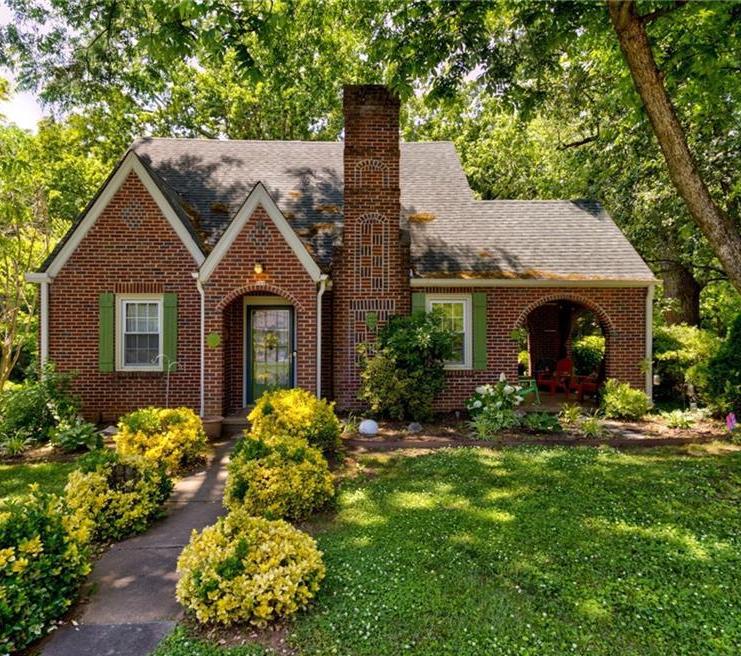
800 Brent Street, Winston-Salem
The Carl and Pauline Charles House
- Sold for $381,000 on July 20, 2023 (listed at $398,900)
- 5 bedrooms, 2 bathrooms, 2,097 square feet, 0.22 acre
- Price/square foot: $182
- Built in 1938
- Listed June 7, 2023
- Last sale: $90,000, April 1991
- Neighborhood: Ardmore Historic District (NR)
- Note: County records show the date as 1942, but the city directory lists the address beginning in 1938.
- District NR nomination: “Period Cottage. One and a half story; side gable; front-gable projection; brick; front-gable entry pavilion; six-over-six, double-hung sash; stuccoed gable ends; recessed entry with arched opening; arcaded, engaged side porch; facade chimney with decorative brickwork.”
- The original residents were Carl Teague Charles (1898-1975), Pauline Hyatt Charles (1904-1998) and their son, Carlyle Hyatt Charles (1927-2022). Charles was a postal clerk. Carlyle grew up to become a colonel in the U.S. Army and is buried at Arlington National Cemetery. Tenants were listed along with the family until 1941. The Charleses lived in the house until 1955.
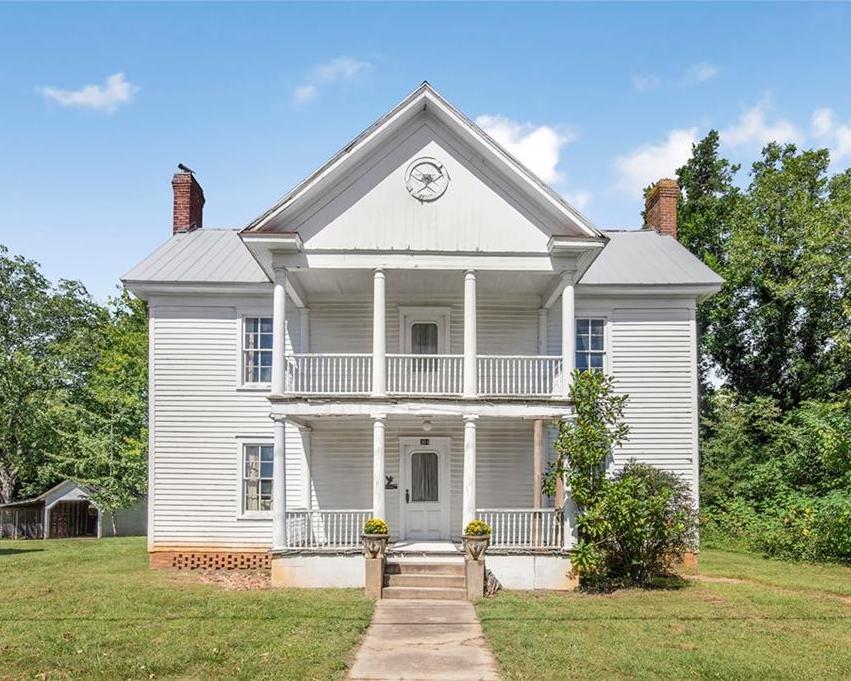
304 W. Main Street, East Bend, Yadkin County
- Sold for $164,250 on July 14, 2023 (originally $199,900)
- 4 bedrooms, 2 bathrooms, 1,982 square feet, 0.90 acre
- Price/square foot: $83
- Built in 1890
- Listed September 26, 2022
- Last sale: $62,500, August 2022
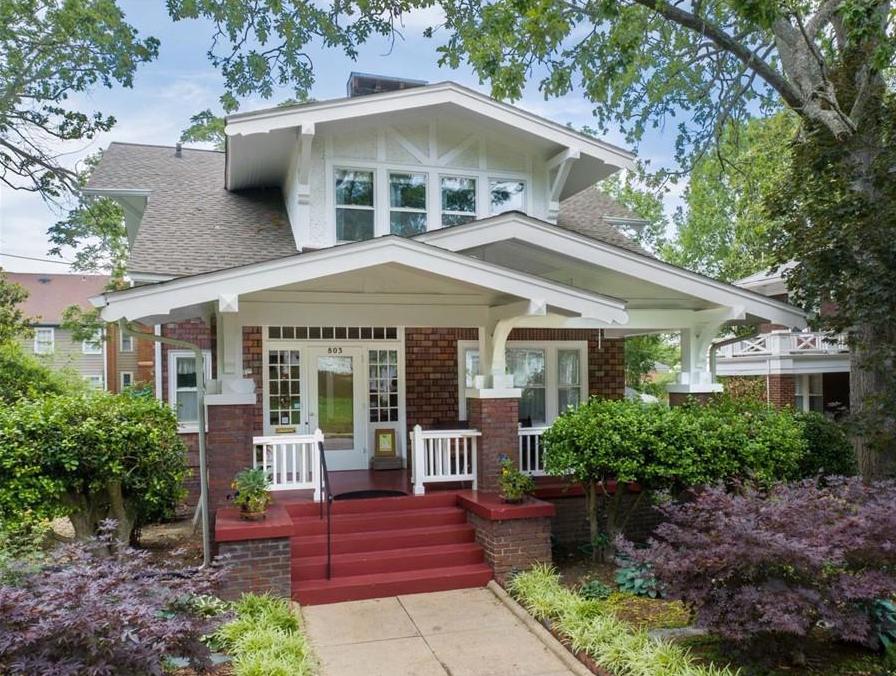
803 Magnolia Street, Greensboro
The Jacob and Elizabeth Cunningham House
- Sold for $540,000 on June 28, 2023 (listed at $525,000)
- 4 bedrooms, 1 1/2 bathrooms, 2,254 square feet, 0.18 acre
- Price/square foot: $240
- Built in 1923 (per county, maybe 1922; see note)
- Listed May 31, 2023
- Last sale: $158,500, May 1993
- Neighborhood: Fisher Park Historic District (local and NR)
- District NR nomination: “Tudor Rev Bungalow … Veneer of oversized bricks laid in Flemish bond pattern; multiple stuccoed and half-timbered gables”
- The address originally was 801 Magnolia.
- The original owners were Jacob Harry Cunningham (1878-1968) and Elizabeth Adams Cunningham (1885-1935). They were listed at the address when it first appeared in the city directory in 1922.
- Harry was president of Cunningham Brick Company and vice president of Cunningham Springless Shade Company. His brother Charles was VP of the brick company and president of the springless shade company.
.
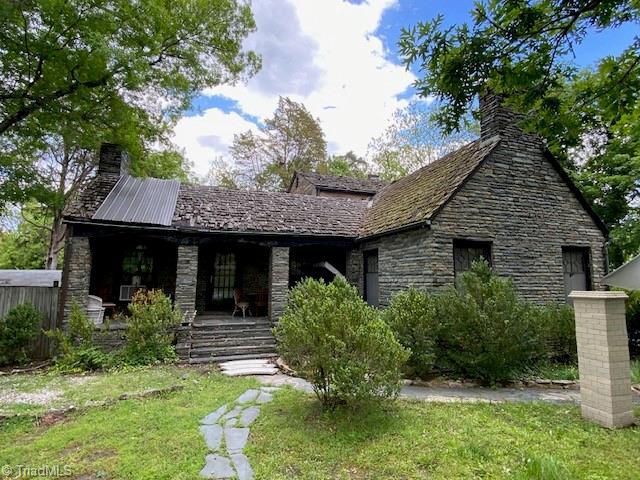


164 N. Jones Street, Denton, Davidson County
- Sold for $175,000 on June 14, 2023 (originally $275,000)
- 3 bedrooms, 3 1/2 bathrooms, 2,473 square feet, 0.39 acre
- Price/square foot: $71
- Built in 1930
- Listed May 8, 2023
- Last sale: $70,500, February 1988
- Neighborhood: Denton Historic District (on National Register study list)
- Note: No central air conditioning
- The exterior is blue slate.
- The property includes a 1-bedroom, 1 1/2-bath “carriage house.”
- The house needs some interior and exterior work.

3007 Riverside Drive, Mount Airy, Surry County
- Sold for $460,000 on June 7, 2023 (originally $479,000)
- 3 bedrooms, 1 bathroom, 2,486 square feet, 6.1 acres
- Price/square foot: $185
- Built in 1864
- Listed September 27, 2022
- Last sale: $61,000, July 1981
- Note: The property includes a pond and creek, a three-stall horse barn with tack room and spring house, and a detached garage with a full bath and an office.
- Located north of Mount Airy on N.C. Highway 104 near the Salem community and the White Sulphur Springs community, a 19th century resort.
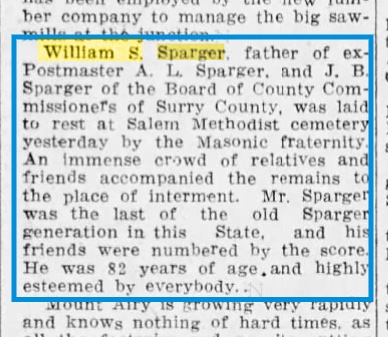
- The State Historic Preservation Office’s map of historic sites shows this property as “Sparger House,” but offers no other details. An 1862 deed shows a property being bought by William Simpson Sparger (1833-1915). The description of the property is vague, but it appears at least to be in the same general area. The deed indicates it was adjacent to another property owned by either William or another member of the Sparger family.
- William was a grandson of Johan Wolfensbarger (17454-1840), the first member of the family to move to Surry County (Johan later changed his name to John W. Sparger).
- William was a farmer, according to census records, and apparently had many friends. A report on his death in The Charlotte Observer said, “An immense crowd of relatives and friends accompanied the remains to the place of interment. Mr. Sparger was the last of the old Sparger generation in the state, and his friends were numbered by the score. He was 82 years of age and highly esteemed by everybody.”
- The house is near the site of the Smith & Sparger Tobacco Factory. Background on the locally prominent family is here and here.

415 Roslyn Road, Winston-Salem
The Gaither-Brown House
- Sold for $1.207 million on June 1, 2023 (originally $1.295 million)
- 4 bedrooms, 5 bathrooms, 5,722 square feet, 0.72 acre
- Price/square foot: $211
- Built in 1928
- Listed May 27, 2022
- Last sale: $50,000 (1/4 interest in property), April 2000
- Neighborhood: Buena Vista
- Note: The property includes a three-car attached garage with an automobile lift and a two-car detached garage.
- The address first appears in the city directory in 1930 as 415 Shady Lane, the original name of Roslyn Road. Moody S. Gaither (1882-1957) and Mittie Florence Perryman Gaither (1885-1981) bought the property in 1928. Moody was a plumbing and heating contractor and secretary of the Master Plumbers Association. He was also a very active real estate trader. In 1931 he lost the property, along with others, to his creditors.
- By 1940, Ralph Bradbury Brown (1906-1949) and Ruth Yates Brown (1908-1999) had bought the house, and it has been in their family ever since. Ralph was president of Southern Steel Company. The house is being sold by one of their grandchildren.
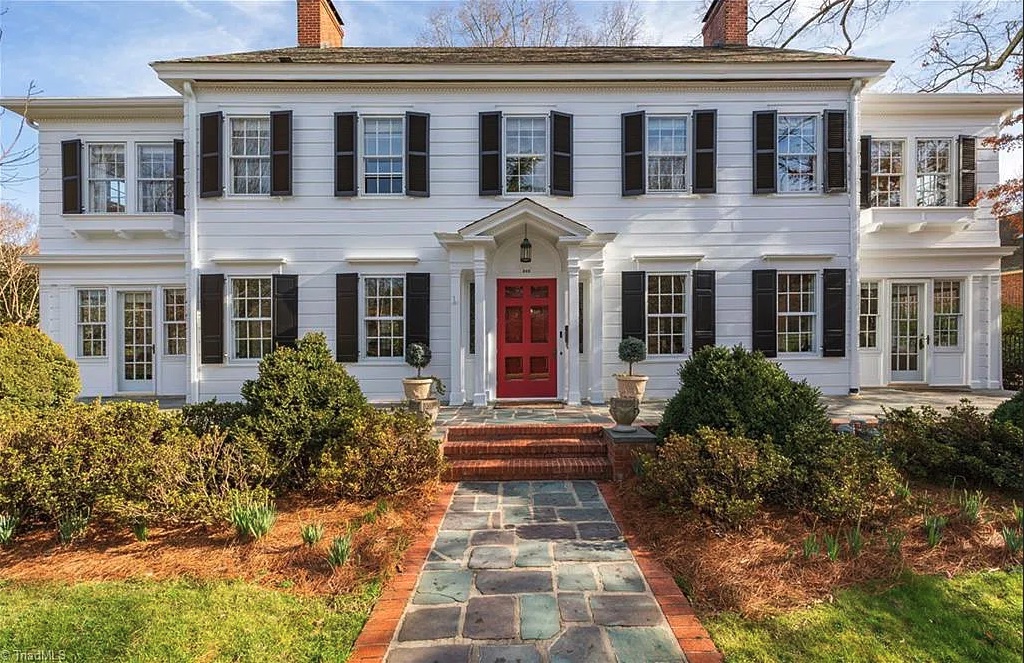
302 Parkway Street, Greensboro
The James and Gayle Thompson House
- Sold for $1.385 million on May 31, 2023 (listed at $1.395 million)
- 4 bedrooms, 3 1/2 bathrooms, 5,072 square feet, 0.51acre
- Price/square foot: $273
- Built in 1924
- Listed March 22, 2023
- Last sale: $790,000, March 2006
- Neighborhood: Fisher Park Historic District (local and NR)
- Note: The listing includes the words extraordinary, impressive (twice), spectacular, opulent, charming, ingratiating, towering, fabulous and special, along with “innumerable possibilities” and “beautifully maintained.”
- District NR nomination: “Georgian, symmetrical, five-bay, rectangular gable-end main block with classical entry portico and reduced-height side wings.”
- The original owners were James Franklin Thompson (1874-1954) and Gayle Quackenbush Thompson (1879-1961). James was president of Gate City Life Insurance Company, and Gayle was vice president. They bought the house in 1925 and owned it for 32 years.

3306 Gaston Road, Sedgefield, Guilford County
- Sold for $1.55 million on May 30, 2023 (listed at $1.399 million)
- 5 bedrooms, 5 full bathrooms, 2 half-bathrooms, 6,808 square feet, 1.09 acres
- Price/square foot: $228
- Built in 1926
- Listed April 20, 2023
- Last sale: $380,000, July 2013
- Listing: The kitchen has two dishwashers, a commercial-grade gas stove, built-in refrigerator, three sinks, “and more.” It also says the kitchen has “leather counter tops.” (Is that a thing? It doesn’t say “leathered granite,” which is a thing.)
- The property includes a swimming pool, cabana, outdoor fireplace and “numerous” outdoor sitting areas.
- The basement has a sauna, safe room, bedroom, full bath and exercise room.
- If the 1926 date is accurate, this is one of the oldest houses in Sedgefield. The community was developed beginning in 1923, when the Southern Real Estate Company bought a 3,660-acre hunting preserve between Greensboro and High Point. Development was slow; by one accounting, only 35 of the community’s 620 homes were built before 1940. About half were built between 1970 and 1999.
- For this particular property, no early history can be found. No deeds earlier than 1946 can be identified online, and no city directories covered Sedgefield, lying well beyond both Greensboro and High Point for decades. Similarly, Sedgefield lies outside area of interest for the two cities’ libraries and history museums.
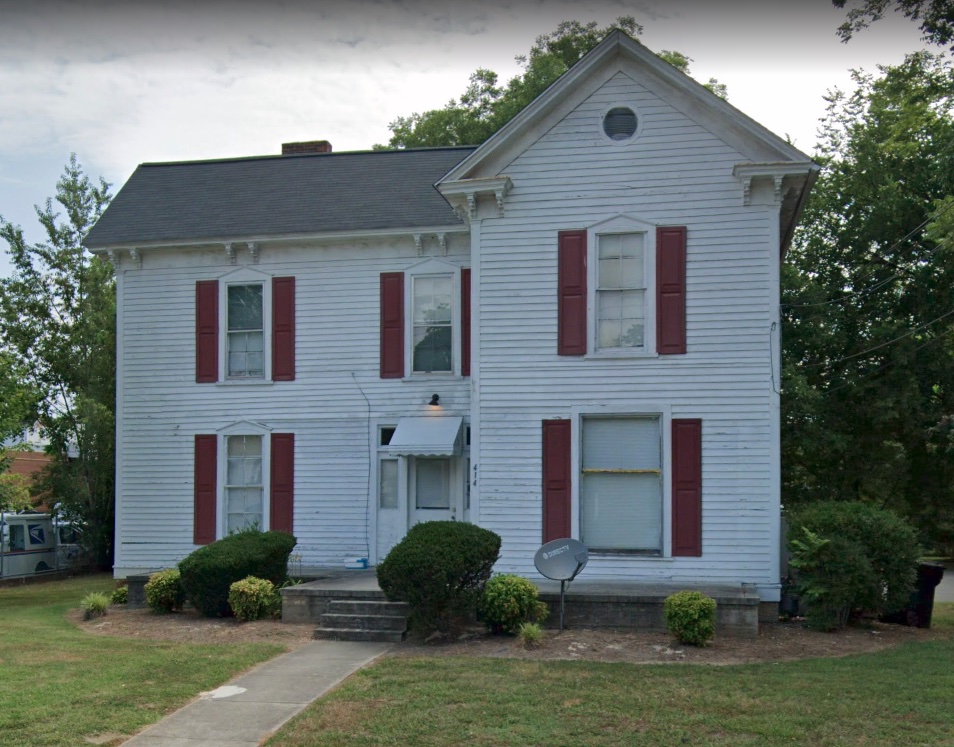
414 E. Morehead Street, Burlington, Alamance County
Episcopal Rectory
- Sold for $170,000 on May 26, 2023 (listed at $160,000)
- 5 bedrooms, 2 bathrooms, 2,755 square feet, 0.50 acre
- Price/square foot: $62
- Built ca. 1890 (per district NR nomination)
- Listed February 16, 2023
- Last sale: $125,000, July 2005
- Neighborhood: South Broad-East 5th Streets Historic District (NR)
- Note: Currently divided into two units
- Tax records show a date of 1950, which appears to be way off.
- District NR nomination: “Well-preserved [as of 2001] 2-story gable-and-wing house of eclectic design, with original siding, an ornate boxed cornice with pendanted brackets, tall 4/4 sash windows with peaked lintels, and an entrance with beveled glass transom and sidelights.
- “The wraparound front porch [now missing] has slender classical columns that are probably early 20th century replacements. The rear ell has been enlarged in recent years.
- “The Episcopal Church apparently built this house as the rectory. D.F. Rudd, painter with the City Schools, bought the house in 1919 and lived here until 1937. Kemp D. Blalock was the owner-occupant from then until 1981.”
- D.F. Rudd was Doctor Franklin Rudd (1880-1950), a janitor and painter with the school system (“Doctor” was his first name). He was married to Mary Elizabeth Rudd (1879-1969).
- Kemp DeWitt Blalock (1884-1959) was a mechanic with P&S Motor Company, the local Hudson automobile dealership. He and the lyrically named Carrie Exie Oakley Blalock (1893-1967) were married in 1909.
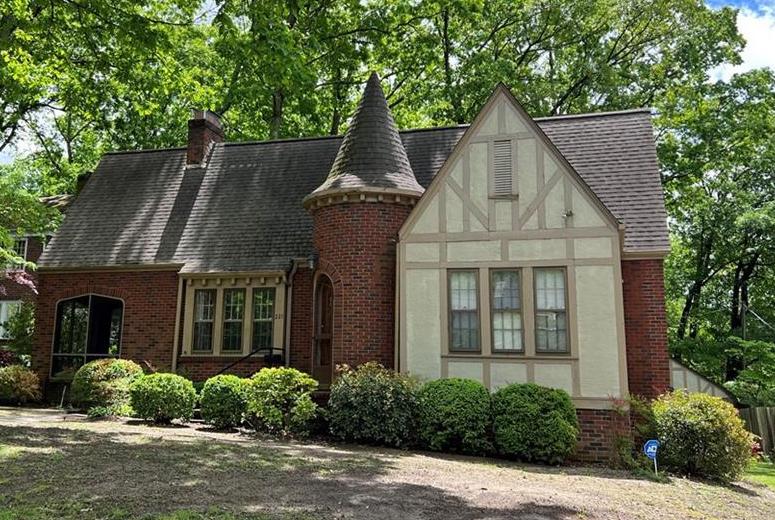
221 Spring Street, Thomasville, Davidson County
The Ethel and Carson Cox House
Blog post — A Memorable 1932 Tudor Cottage in Thomasville, $259,000
- Sold for $247,500 on May 24, 2023 (listed at $259,000)
- 3 bedrooms, 2 bathrooms, 2,290 square feet, 0.29 acre
- Price/square foot: $108
- Built in 1932
- Listed May 1, 2023
- Last sale: $169,900, May 2019
- Neighborhood: Colonial Drive School Historic District (local)
- Note: Ethel Elizabeth McCormick Cox (1891-1973) bought the property in 1920, and it remained in the Cox family for 99 years. Although she had married Carson Clay Cox Sr. (1893-1948) by then, her name alone was on the deed. By 1933 they had built the house and were living there.
- Carson was a coffee roaster and later vice president and general manager of the Lexington Grocery Company. He served on the Thomasville school board and during World War II on the local draft board and ration board.
- Their son, Carson Jr. (1926-2000), and his wife, Pauline Phillips Walker Cox (1930-2017), owned the house after Ethel. Twelve heirs sold the property in 2019.

812 Ferndale Boulevard, High Point
The Robert and Helen Armfield House
- Sold for $320,000 on May 23, 2023 (listed at $300,000)
- 3 bedrooms, 2 bathrooms, 2,380 square feet, 0.29 acre
- Price/square foot: $134
- Built in 1948
- Listed April 30, 2023
- Last sale: $192,000, September 2015
- Note: The house is across the street from High Point Central High School.
- The street was called Jones Street when the house was built. The house number has always been 812.
- It had only two owners in its first 59 years.
- The original owners were Robert David Armfield (1905-1963) and Helen Allred Armfield (1910-1993). Robert was a printer for the Greensboro Daily News.
- Helen sold the house in 1964 to James Herbert Blair (1925-2009) and Helen Marie Bayne Blair (1926-1973). James was a Navy veteran of World War II. He was co-owner of Green House Fabrics. Herbert and his second wife, Edith Lucille Calloway Blair (1932-2017), sold the house in in 2007.

462 Lockland Avenue, Winston-Salem
The Jesse and Mabel Bowen House
- Sold for $420,000 on May 18 (originally $479,000)
- 5 bedrooms, 2 bathrooms, 2,905 square feet, 0.21 acre
- Price/square foot: $145
- Built in 1923
- Listed March 16, 2023
- Last sale: $299,000, July 2020
- Neighborhood: Ardmore Historic District
- District NR nomination: “A variation of the Colonial Revival style, Dutch Colonial Revival, is unusually common in Ardmore with close to fifty examples. … [An] unusually large example is the Bowen House (c.1923, 462 Lockland Ave.). It features weatherboard siding, pressed tin shingle roof, shed-roof dormer sheathed in wood shingles, and a hip-roof porch with square posts. …
- “Gambrel roof; two story … weatherboard; eight-over-one, Craftsman-style windows; hip-roof porch; square posts; shingled gable ends; lunette windows in gable ends.
- The house was built by the notably long-lived Jesse Gray Bowen (1882-1976), who died at age 93, and Mabel Douglas Bowen (1891-2001), who lived to be 109. They were still living in the house in 1963, 40 years later.
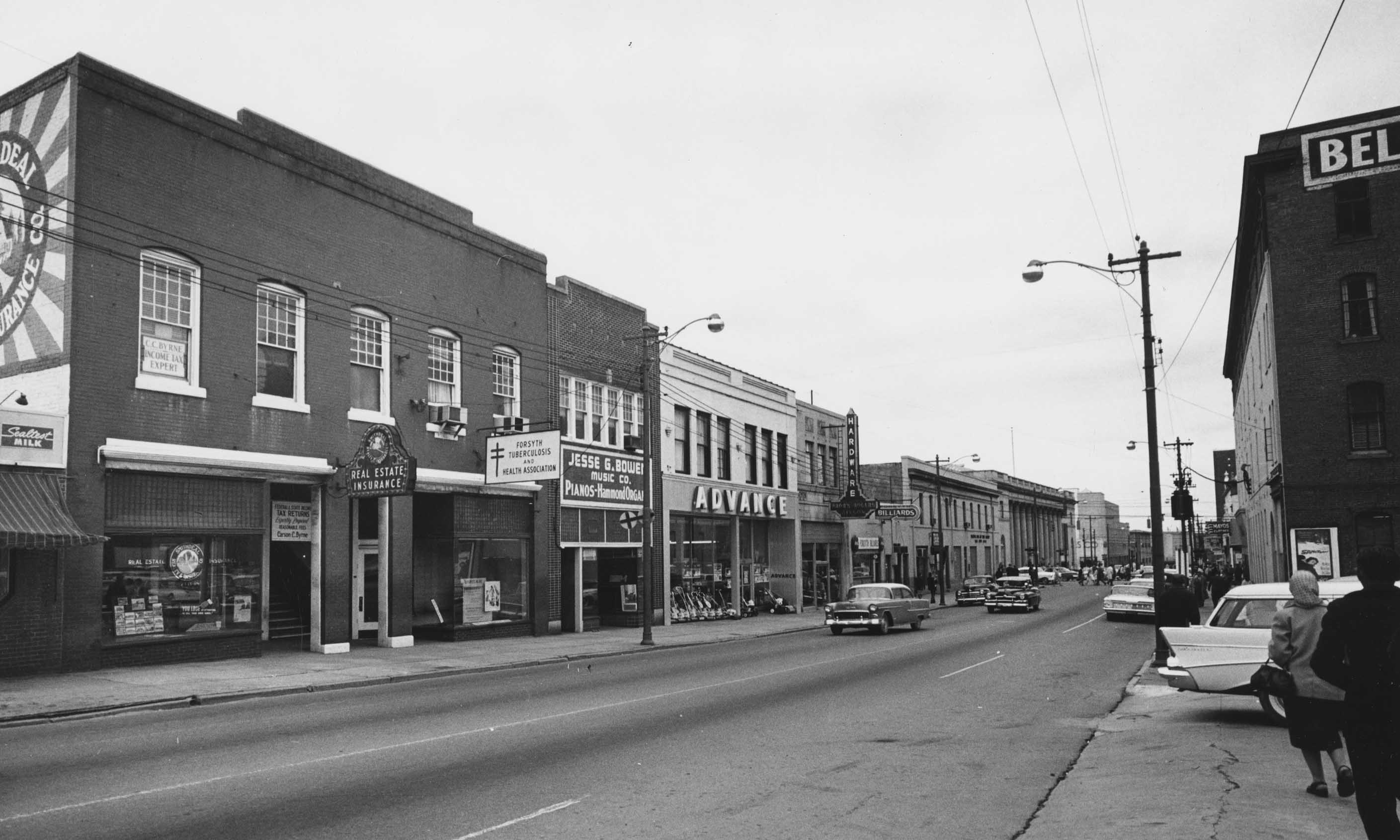
- Jesse founded Jesse G. Bowen & Company downtown (1902 and 1918 are given by various sources as the date). It sold pianos, player-pianos and organs. He later took their son, Jesse Jr., as his partner. Jesse Jr. was sole owner when he died in August 1976 at age 62.
- When Jesse Sr. established the business, his older brother, Robert Jordan Bowen (1869-1959), operated a company called Bowen Piano Company in Winston-Salem.
- Jesse G. Bowen Music Company in 1961 on West 5th Street (Forsyth County Public Library Photograph Collection):
.


1129 N.C. Highway 65, Wentworth, Rockingham County
Blog post — 4 Historic Former Neighborhood Stores For Sale as Homes or Outbuildings
- Sold for $130,900 on May 12, 2023 (originally $189,900)
- Two houses and an old store building, 4 acres total
- The Dewey Adams House, 1935: 2 bedrooms, 1 bathroom, 1,164 square feet
- The Robert G. Mitchell house — county tax card: 1907, bedrooms and bathrooms not listed, 1,216 square feet, no heat, no electrical, construction grade F, unsound condition
- The Robert G. Mitchell Store — county tax card: 1900, 720 square feet, no heat, no electrical, construction grade F, unsound
- Price/square foot: $42
- Listed March 3, 2022
- Last sale: Not identifiable in online records
- Note: The properties are in Wentworth but have a Reidsville mailing address.
- The listing gives dates for the buildings that vary slightly from county records.

923 Country Club Drive, High Point
The James and Jesse Millis House
- Sold for $1.2 million on May 9, 2023 (listed at $1.2 million)
- 5 bedrooms, 7 bathrooms, 6,812 square feet, 0.85 acre
- Price/square foot: $176
- Built in 1960
- Listed February 28, 2023
- Last sale: $650,000, September 2021
- Neighborhood: Emerywood
- Note: Currently owned by an LLC based in Las Vegas
- The lot was vacant for decades after the neighborhood was initially built out. James Henry Millis (1923-2004) and Jesse Ellsworth Evans Millis (1925-2010) bought the property in 1954 and owned it for 58 years.
- James was a grandson of James Henry Millis (1849-1913), co-founder of Adams-Millis Corporation. The younger James became CEO of the company, then the largest manufacturer of hosiery in the world. He had been a P-47 fighter pilot in World War II before spending his entire career at Adams-Millis. James and Jesse met when they were students at the McCallie School in Chattanooga. Their children sold the house in 2012.

419 S. Main Street, Kernersville, Forsyth County
The Stockton-Gibson House
The Gibson House Inn
- Sold for $497,000 on May 8, 2023 (originally $529,000)
- 5 bedrooms, 5 1/2 bathrooms, 4,442 square feet, 0.65 acre
- Price/square foot: $112
- Built in 1837
- Listed March 6, 2023
- Last sale: $238,000, February 2019
- Note: The property is next door to Korner’s Folly.
- The inn’s website says the house was built by Doughty Stockton (1776-1855) and Elizabeth Perkins Stockton (1798-1858). Doughty, too, operated an inn. An obituary in The People’s Press said, “While his long useful and laborious life for the last forty-seven years was devoted to serving the public as a Landlord, with the noblest impulses and with a sensibility alive to the tenderest wishes of the weary traveller, his influence was ever exerted to render them comfortable and happy. He always discharged his duties with a dignity and propriety of conduct, which conciliated the regard and secured for him the love and esteem of all who knew him.”
- The house apparently stayed in the Stockton family, with great-granddaughter Agnes C. Stockton Gibson (1877-1910) and her husband, Edward Hiram Gibson (1865-1926), taking ownership in the early 20th century. Their son, Edward Hiram Gibson III (1900-1973) sold the house in 1963. He was a history professor at Appalachian State University.
- The house became an antiques store in the 1960s, then a mission church for Holy Cross Catholic Church from 1969-1982 and then an antiques store again. It became an inn again after the current owners bought it in 2019.
1939 N.C. Highway 57 N., Milton, Caswell County
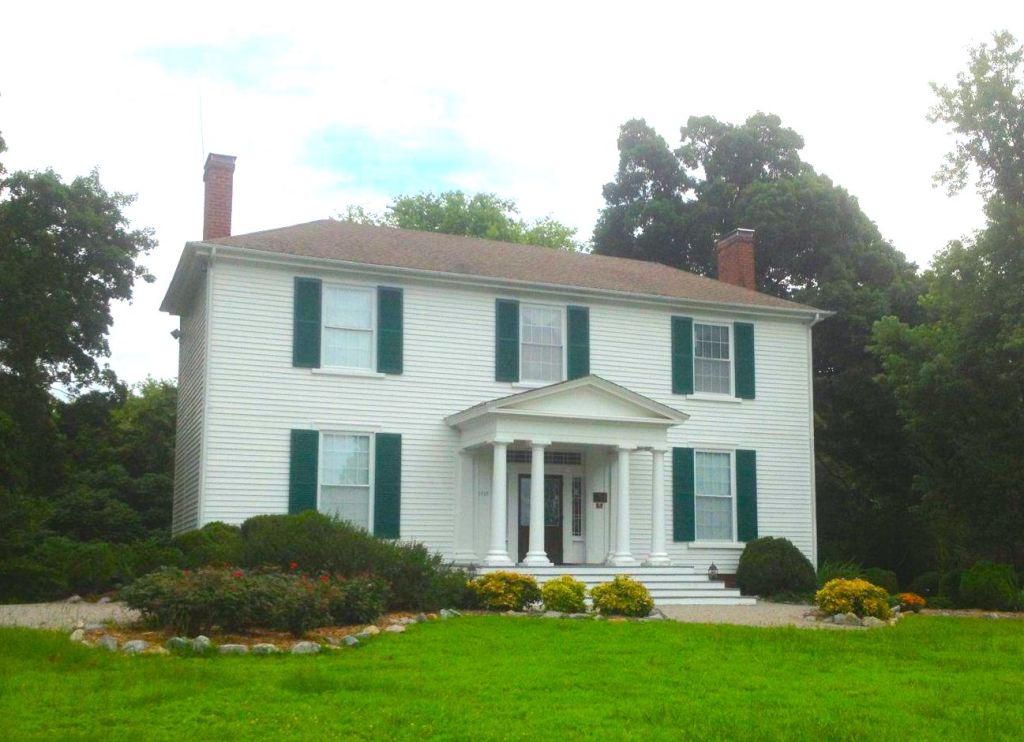
Woodside, the Caleb Hazard Richmond House
National Register of Historic Places
Blog post — Woodside: An 1838 Mansion in Caswell County on the National Register, $595,000
- Sold for $395,000 on May 4, 2023 (originally $595,000)
- 5 bedrooms, 5 1/2 bathrooms, 4,400 square feet, 5 acres
- Price/square foot: $90
- Built in 1838
- Listed January 19, 2022
- Last sale: $75,000, December 2021
- Note: The property is under protective easements held by the Historic Preservation Fund of North Carolina.
- Woodside had fallen into serious disrepair by the time it was nominated for the National Register. In the 1990s, it was restored as a bed and breakfast and restaurant, which operated as recently as three years ago.
- The house is about two miles southeast of Milton.
- Listing: “Thomas Day Staircase.” News & Record, April 18, 1995: “Woodside is filled with beautifully executed woodwork attributed to Thomas Day, Milton’s free black craftsman. A fine example of the workmanship is the mahogany staircase railing which ends in a nautilus-shaped swirl.”
- National Register nomination: “Woodside, the home of Caleb Hazard Richmond in northeastern Caswell County, is a splendid … example of Greek Revival residential architecture produced during the county’s ‘Boom Era’ in the middle decades of the 19th century.
- “Standing on its elevated site some 2 miles east of the small town of Milton, Woodside overlooks the surrounding countryside that produced the bright-leaf tobacco which was the mainstay of the county’s economy during that boom period. …
- “The large house was once the seat of a plantation consisting of 350 acres and was probably built in the late 1830s, shortly after Richmond married his second wife, Mary R. Dodson, and within a few years after he had made his first land purchase in the county.
- “Although only 5 of those 350 acres are now associated with the house and only one of the numerous outbuildings which supported the household survives, Woodside remains as a vivid reminder of the prosperity which characterized the county during the period from the late 1830s until the Civil War.”
- “Typical of the substantial houses constructed in the county during the period, Woodside is a large dwelling of simple vernacular form finished with well-executed pattern-book Greek Revival details.
- “The fine interior woodwork, including the distinctive scrolled staircase newel and bowed parlor mantel flanked by niches, is attributed to Thomas Day. Day was a superior craftsman and free black who operated a furniture-making shop in nearby Milton and is credited with creating many of the county’s finest interiors during the ‘Boom Era.’
- “It was at Woodside that the Confederate officer (later general) Dodson Ramseur met, courted and married (1863) Ellen Richmond, daughter of Caleb.” Dodson and the soon-to-be-widowed Ellen were cousins.
- Dodson was from Lincolnton. Although much is made of his connection to the house, he stayed there only briefly during the war, including some months while recovering from wounds. A roadside plaque on the property is devoted to him, put up by the Daughters of the Confederacy and the “Military Order of Stars and Bars.”
- A laudatory article on Dodson in America’s Civil War magazine recounts his “conspicuous gallantry,” “magnetic leadership” and victories in battle but also notes his “unaccountable lapses,” staggering numbers of his troops being “slaughtered,” poor decisions, mistakes, and rashness. He ultimately died as a prisoner of Union generals Sheridan and Custer after after attracting heavy fire as one of the conspicuously few men on horseback during an October 1864 battle in the Shenandoah Valley. His only child, Mary, had been born four days earlier.
- The Caswell County Historical Society relates the sad consequences for his family: “Ellen Ramseur never remarried and wore black mourning clothing for the rest of her life. She remained with her family in Caswell County until she died in 1900 at the age of fifty-nine. Mary Ramseur never married and died at the age of seventy-one in 1935.”
- Curiously, the civil-war magazine article says, one Dodson’s best friends at West Point had been the same George Armstrong Custer, who ultimately took Dodson prisoner and eventually outperformed Dodson as an author of battlefield catastrophe. “Stephen Dodson Ramseur and George Armstrong Custer were just about as unlike as any two cadets who had ever attended the U.S. Military Academy. Custer, nicknamed Fanny by his fellow cadets, was tall, blond and voluble. A poor but popular student, he chafed at the restrictions and rules at West Point.
- “Ramseur, on the other hand, was a small, darkly handsome young man whose natural reserve hid an underlying strength of purpose. While not an outstanding student, he applied himself well enough to finish in the top third of the class, and his leadership skills made him captain of cadets.
- “Deeply religious, he was also a staunch Southerner who, since a Yankee had ruined his father in a business deal, had little use for anyone from the scheming, cold-hearted North. He politely defended states’ rights and the institution of slavery, which he called the very foundation of our existence.
- “Yet the two cadets had become friends, for they did have more than a few things in common. Both were superb athletes, especially on horseback. And although Ramseur was very religious, he was not an insufferable Puritan like some of the New Englanders, and certainly was not too good to enjoy a joke, a drink or a twist of tobacco.
- “In short, he was a boon companion and as such was willing to accept Custer, Merritt [a future Union general and cavalry commander] and a few others from his general dislike of Northerners. Wes Merritt thought him one of the most universally beloved men in the class.”
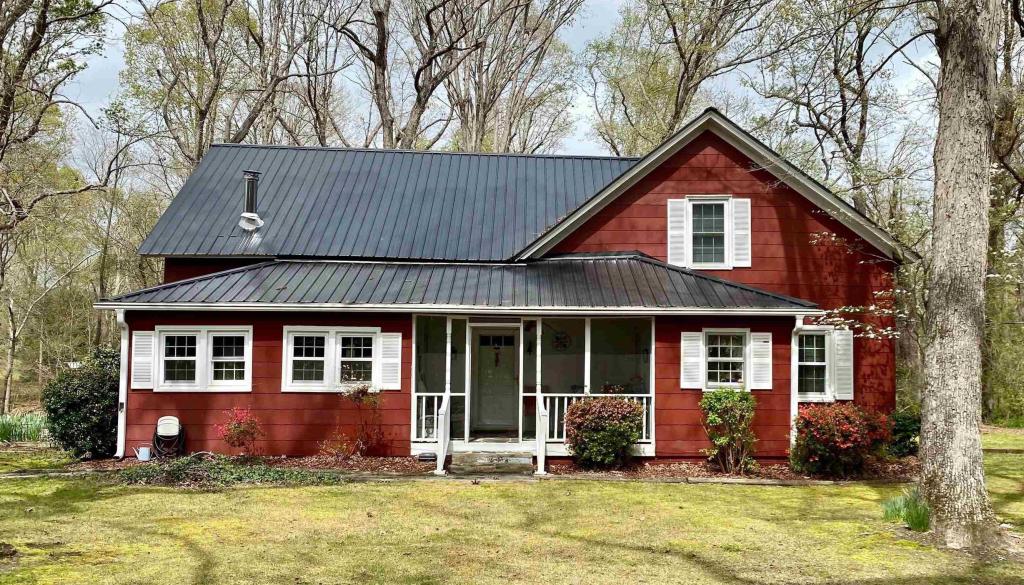
4430 E. Greensboro Chapel Hill Road, Eli Whitney
- Sold for $370,000 on May 4, 2023 (listed at $383,000)
- 4 bedrooms, 2 bathrooms, 2,367 square feet, 1.75 acres
- Price/square foot: $156
- Built in 1890
- Listed April 6, 2023
- Last sale: September 1969, price unknown
- Note: The mailing address is Graham, but the property is in the Eli Whitney community in southern Alamance County.
- The house was built as a school. It was moved to its current location in 1968.
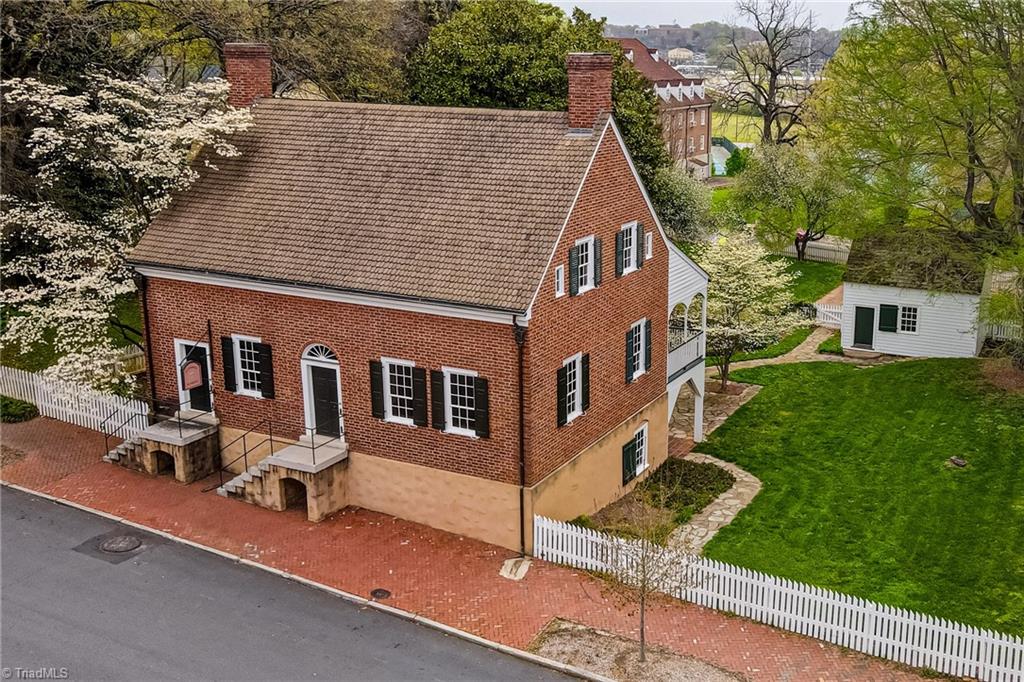
807 S. Main Street, Old Salem
The Traugott Leinbach House
- Sold on April 28, 2023, price not listed on deed (listed at $635,000)
- The seller was the executor of a will; the buyers appear to be the children of the deceased man.
- 3 bedrooms, 4 1/2 bathrooms, 2,155 square feet, 0.39 acre
- Price/square foot: $295
- Built in 1974 (see note)
- Listed April 6, 2023
- Last sale: $200,000, March 1991
- Neighborhood: Old Salem Historic District (local and NR)
- Note: The house is a faithful reconstruction of the 1824 house built by silversmith Traugott Leinbach, using handmade brick, Hendricks tile for the roof, copper gutters, antique hardware and locksets, handmade lighting fixtures, antique mantels and millwork.
- The property includes a detached guesthouse/office of about 300 square feet with a full bathroom.
- District NR nomination: “The Traugott Leinbach House was reconstructed in 1974 by Thomas Gray, who had previously restored the Christman House, Lot 74, 500 Salt Street.
- The Leinbach house is built against the sidewalk and has a picket fence surrounding the lot. The house is a one and one-half story Flemish bond brick building with side gable roof (ceramic tile) with flush ends and a kick at the eave. The box cornice has bed molding and a plain frieze board.
- “The house has interior end chimneys with corbelled caps and is on a high stuccoed foundation. It was the last house in Salem to be constructed in the Flemish bond.
- Built as a house/shop configuration, the façade has five bays with two entries. The centered entry to the residence is a six panel door with a fanlight; the shop entry is also a six panel door. Each door has a stone door sill at a brick and stucco arched stoop with a flight of stone steps off the north ends of each, down to the sidewalk.
- “Window sash is nine-over-six with six-over-six sash on the second floor at the gable ends and flanked by vertical two-light attic casements. Windows are hung with three panel shutters and are evenly spaced.
- “A shed roof addition is across the rear and partially enclosed (weatherboard). The enclosed portion has a reconstructed masonry bake oven with stucco and a brick chimney.
- “The open porch has chamfered posts with arch decoration and simple balustrade. There is a full story cellar, with grade level access at the rear due to the sloping lot. Window sash at the cellar is six-over-six with single leaf shutters.
- “The plans for the house were presented by Traugott Leinbach in October 1823 and construction was completed in 1824. Leinbach had apprenticed to renowned silversmith John Vogler (Lot 64, 700 S. Main Street) and became even more accomplished in hollow ware than his teacher.
- “In 1854 Leinbach, silversmith and watchmaker, constructed a three-story addition to the north side of his house. His interests were many, including, galvanic battery operations and Daguerreotype photography.
- “In 1860, Leinbach moved to Bethlehem, Pennsylvania, and the house and lot were turned over to son Felix. … Outbuildings recorded on the 1885 Sanborn Insurance maps included a kitchen and large shed; the attached bake oven is noted as well.”
- By 1912, the house had been demolished. Four houses were built on the lot; they’ve all been removed.

508 McReynolds Street, Carthage, Moore County
The Dr. John Shaw House
- Sold for $120,000 on April 10, 2023 (listed at $130,000)
- 3 bedrooms (per county), 2 1/2 bathrooms, 2,540 square feet, 1.49 acres
- Price/square foot: $47
- Built in 1853 (per county, but perhaps earlier; see note)
- Listed March 24, 2023
- Last sale: December 1982, price not recorded on deed
- Neighborhood: Carthage Historic District (NR)
- Note: The listing gives the date of the house as 1800 and says it has 4 bedrooms.
- “The home has no utilities.”
- The listing says the owners who sold the property in 1853, the Glascocks, “were first cousins of (President) George Washington, and it is said that a young George Washington would come from Virginia to visit his cousins the Glascock’s.”
- The historic district’s National Register nomination references the Glascock family but doesn’t mention George Washington: “frame house combining three periods of construction and architectural style: gable-front, two-story wing with one-story, single pile, gabled wing extending to east at perpendicular; one-story porch shelters three front bays of one-story east wing, enclosed on east elevation;
- “has bracketed turned posts, sawn balustrade, molded handrail; one-story rear ell; rear porches enclosed; beaded siding with rosehead nails on rear wall of one-story wing under enclosed porch; aluminum siding on rest of house;
- “nine-over-nine and six-over-six windows; paved single-shoulder, exterior-end chimneys on west elevation of two-story wing;
- “Italianate door with tabernacle panes, contemporary with late 19th century porch, opens to broad hall connecting two wings; rear door, next to beaded siding is early 19th century raised six-panel beneath transom; other doors are two-panel, matching several mid 19th century Greek Revival mantels; single Italianate mantel on second floor; quarter-turn with landing stair begins in hall, rises between rooms in two-story wing;
- “Dr. John Shaw, purchased tract known as Patty Glasscock land in 1853, apparently made additions to small existing house, probably dating to second quarter of 19th century; Patty Glasscock was widow of Dr. John Glasscock;
- “Dr. Shaw was physician and prominent town and county citizen — Register of Deeds, county commissioner, two terms in state house of representatives, trustee of Carthage Academy.”
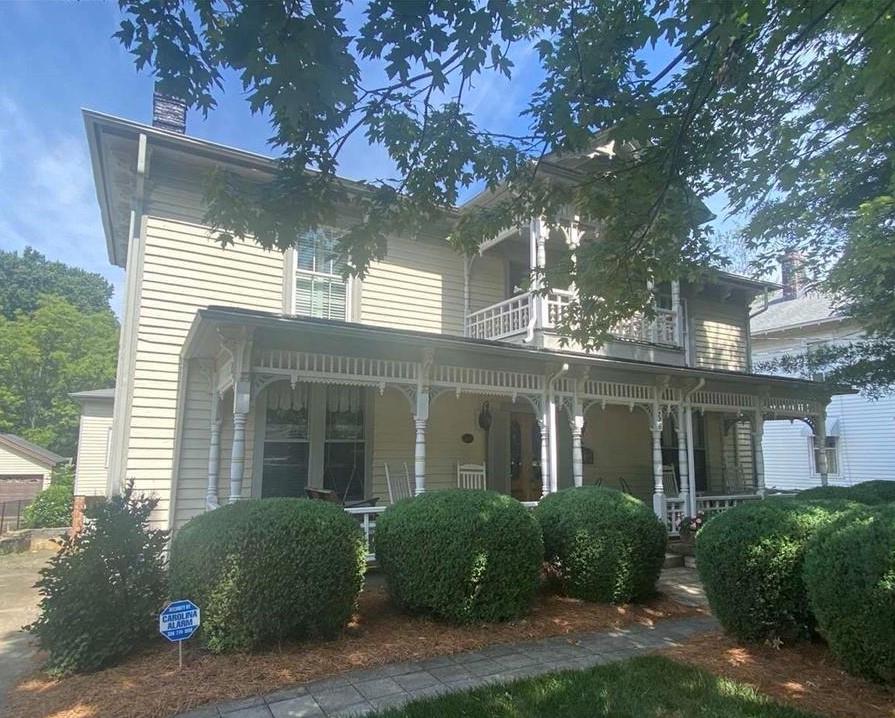
716 S. Main Street, Reidsville, Rockingham County
The Wray-Rainey-Webster House
Blog post — New Listing: The 1850 Wray-Rainey-Webster House in Reidsville, $350,000
- Sold for $334,000 on March 30, 2023 (listed at $350,000)
- 4 bedrooms, 3 1/2 bathrooms, 3,494 square feet, 0.23 acre
- Price/square foot: $96
- Built in 1850 (per county)
- Listed January 20, 2023
- Last sale: July 1986, price unknown
- Neighborhood: Reidsville Historic District (NRHP), Old Post Road Historic District (local)
- Note: The listing gives the date of the house as 1860. the district’s National Register nomination puts it at circa 1860.
- District NRHP nomination: “Believed to be one of the oldest houses surviving in the district, this two-story frame residence has changed hands more than most of the pivotal houses, and its original location was some one hundred yards to the south on the present site of the Hugh Reid Scott [House].
- “The first occupant is said to have been Richard H. Wray, a later postmaster of Reidsville, although supporting documentation has not been found. The first recorded owner was John Rainey, a farmer, who was followed by Colonel John R. Webster (1845-1909), publisher of Webster’s Dollar Weekly, and later by Hugh Reid Scott, as well as several others.
- “These changing ownerships have resulted in alterations to the house, although the exterior of the front section remains relatively intact in its late 19th century appearance. This two-story single-pile section is topped by a low hipped roof of standing seam tin with deep bracketed eaves and a paneled frieze, relating it to more elaborate Italianate houses in the district.
- “The three-bay facade is spanned by a one-story Eastlake-style porch with central two-tier pedimented pavillion. Ornamentation includes a spindled frieze, turned and bracketed posts, spindle balusters, and sawn gable ornament on the porch and paneled cornerboards.
- “Windows are six over six sash in simple surrounds, and the brick chimneys rise in an interior end location.
- “A one-story, two-room ell was added across the rear early in the 20th century; a more recent one-story addition rests on brick piers.”
- The Colonel started Webster’s Dollar Weekly in 1875. At some point in the 1880s, it was renamed Webster’s Weekly. It was published until 1916.

305 E. Hendrix Street, Greensboro
The John and Helen Kleemeier House
- Sold for $424,900 on March 15, 2023 (listed at $424,900)
- 3 bedrooms, 2 bathrooms, 1,745 square feet, 0.11 acre
- Price/square foot: $243
- Built in 1918
- Listed February 1, 2023
- Last sale: $335,000, February 2021
- Neighborhood: Fisher Park Historic District (local and NR)
- Note: The property includes a wired storage building.
- District NR nomination: The original owners were John August Kleemeier (1879-1957) and Helen L. Bouldin Kleeneier (1884-1920). John, a native of Cincinnati, was president of Wysong & Miles. He sold the house in 1937.
- Wysong & Miles was a manufacturer of machine tools and woodworking machinery established in 1903 (still in business).
- For 48 years, from 1955 to 2003, the house was owned by Guy Delafield (1920-2008) and Letitia Carter Delafield (1920-2008). Guy was the office manager for the Lassiter Corporation, which sold cellophane products. Carter was an associate professor of English at Guilford College. She received her master’s degree in English from UNCG in 1966. Her thesis was titled, “Flannery O’Connor: Prophet and Evangelist.”
- Guy and Carter were born six months apart in 1920 and died eight days apart in February 2008.

214 N. Main Street, Troy, Montgomery County
The Wade-Arscott House
Blog post — The Wade-Arscott House: A Much-Admired Judge’s 1871 Queen Anne in Troy, $369,000
- Sold for $365,000 on March 1, 2023 (listed at $369,000)
- The deed was signed March 1 but wasn’t filed until April 5.
- 4 bedrooms, 4 bathrooms, 3,474 square feet, 0.24 acre
- Price/square foot: $105
- Built in 1871
- Listing date unknown
- Last sale: $120,000, December 2016
- Neighborhood: Troy Residential Historic District (NR)
- Note: Now a well-reviewed B&B
- One of five structures in the tiny Troy Residential Historic District
- District NR nomination: “A notable example of Queen Anne architecture in Troy is the two-and-a-half-story Wade-Arscott House, a rambling frame residence that is enlivened by widely spaced windows, a one-story wraparound porch supported by square posts and enclosed by plain balustrades, a cylindrical, weatherboarded and shingled tower capped by a helmet roof at the southwest corner of the structure, and a peaked gable dormer incorporating a recessed balcony.
- “Two entrances afford access to the house: from Main Street, steps lead to a central bay containing a four-panel door framed by paneled sidelights and a three-section transom; on the south side, similar steps rise from the driveway to the porch where a glazed upper-panel door opens into a narrow stair hall.
- “Windows contain two-over-two sash within simple frames, but the upper story of the tower is enlivened by small-paned curved sash containing colored glass inserts. A heavy cornice surrounds the house and the gabled roofs are covered with asphalt shingles. A large central chimney rises through the roof ridge, while a secondary flue marks the location of the kitchen in the rear wing.
- “Inside, the house appears to have two separate construction dates. Marks in the floors and walls of the North section indicate that the two-story house originally contained two rooms, with four Greek Revival-style mantels, two-panel doors and a staircase in the Northeast corner of the North room.
- “According to Richter’s Montgomery County Heritage, this portion was built in 1871 for Christopher Columbus Wade (1837-1915), Judge of Probate, and his wife, Sarah Margaret DeBerry (1845-1920).
- “In the 1890s he enlarged the structure by removing the walls and stairs in the old section, and extending the house to the south with a wraparound porch, cylindrical tower, and a new entrance and staircase opening to the South porch.”
- C.C. Wade (1837-1915) enlisted in the Confederate Army in 1861 at age 24, soon contracted bronchitis and was invalided out eight months later. He and Sarah were married in 1866. He became the county clerk of court in 1868, serving for 21 years. In 1904 he was elected state House; he declined to seek re-election, “preferring the quiet of his home and attention to his farming and business interests,” The Asheboro Courier related in a wonderfully laudatory obituary. The newspaper called him “an able, wise, prudent member, always carefully guarding the public good. Few members have served in the general assembly in our memory who ranked higher.
- “His wisdom and sound judgment appealed to all, and his advice was often sought and always followed. His long experience and knowledge of men and public affairs peculiarly fitted him for the position.”
- In 1930, 10 years after Sarah’s death, the house was sold by the administrator of C.C.’s estate for $8,015 in a public auction. The estate may have been a complicated one; parties to the sale included at least seven descendants, three other individuals and, perhaps reflecting diverse business interests on C.C.’s part, the American Exchange Bank of Greensboro, Stylebuilt Garments Company, Process Trim Hat Company, Flo Frocks Inc., and G.W. Allen & Son.
- The property was purchased in 1946 by Lloyd Arscott (1901-1967), owner of a local office supply business, and his wife, Millie Blake (1906-1996). Their children sold the house 51 years later for $88,000.
- After that, the house may have fallen on hard times. It was sold for $37,000 in 2003 and $21,000 in 2004. It apparently was restored before selling for $120,000 in 2016.
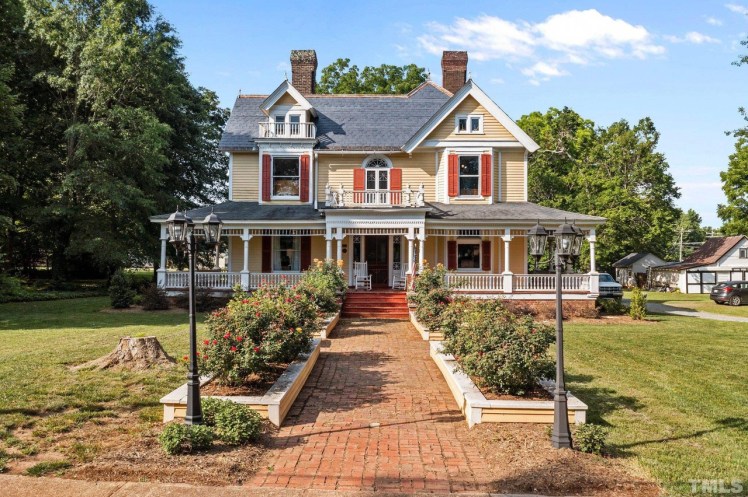
204 E. Railroad Avenue, Gibsonville, Guilford County
Blog post — National Register Property For Sale: Gibsonville’s ‘Most Stylish and Impressive’ Turn-of-the Century Home, $425,000
The Francis Marion Smith House
- Sold for $350,000 on February 28, 2023 (originally $475,000)
- 4 bedrooms, 2 1/2 bathrooms, 3,536 square feet, 1.12 acres (per county)
- Price/square foot: $99
- Built in 1898
- Listed June 9, 2022
- Last sale: $143,500, August 1989
- Note: County records show the square footage as 1,921, which looks way off.
- The property includes a storage building and a gazebo.
- NRHP nomination: “The Francis Marion Smith House, erected in 1898, is the most stylish and impressive residence in Gibsonville surviving from the 1890-1910 period that witnessed the town’s major growth.
- “The two-and-a-half-story frame house combines elements of the Colonial Revival and Queen Anne styles, including an elaborate program of classical trim and turned ornament.
- “It is one of three notable late nineteenth and early twentieth residences associated with the Whitsett Institute, a boarding secondary school and junior college in the Whitsett community near Gibsonville. The three houses (one of which has already been listed in the National Register) are among the finest houses combining Colonial Revival and Queen Anne style elements in eastern Guilford County.
- “Francis Marion Smith [1864-1910] was a farmer, businessman, and civic official in and around Gibsonville. His wife, Lizzie E. Whitsett [1869-1922], taught at the Whitsett Institute both before and after her marriage.”
- Lizzie’s brother was the renowned William Thornton Whitsett, founder of the institute. The 1883 mansion of their father, Joseph Bason Whitsett, is now under contract to be sold; the listed price is $1.3 million. The property, located on U.S. 70 just east of Whitsett, includes 11 acres of land.
- The Smith house remained in the Smith-Whitsett family until 1976. Lizzie bequeathed the house to her sister, Effie Whisett Joyner (1877-1976). After her death, the house was sold for $20,000 to Jerry Nix, who has restored several historic properties in Gibsonville. Nix sold it to the current owners in 1989.

2001 Crescent Drive, Graham, Alamance County
The Jim and Jane Ferrell House
- Sold for $687,500 on February 24, 2023 (originally $787,500)
- 4 bedrooms, 3 1/2 bathrooms, 5,219 square feet, 1.84 acres
- Price/square foot: $132
- Built in 1978
- Listed August 26, 2022
- Last sale: The property hasn’t been sold since the house was built.
- Listing: “Based off an original design by architect Avriel Shull.” Avriel Joy Christie Shull (1931–1976) was an architectural designer/builder and interior decorator who worked primarily in Indiana. She is best known for her mid-century modern residential designs. In the 1970s she began selling house plans in do-it-yourself home-building magazines.
- Something you don’t see every day: “large entertainment room with bar and dance floor”
- The property was bought in April 1975 by James Miller Ferrell (1938-2017) and Katherine Jane “Pookie” Ferrell (1937-2021). They operated Ferrell Manufacturing Company in Graham. At the time of his death, Jim had remarried and was living in Kyiv, Ukraine.
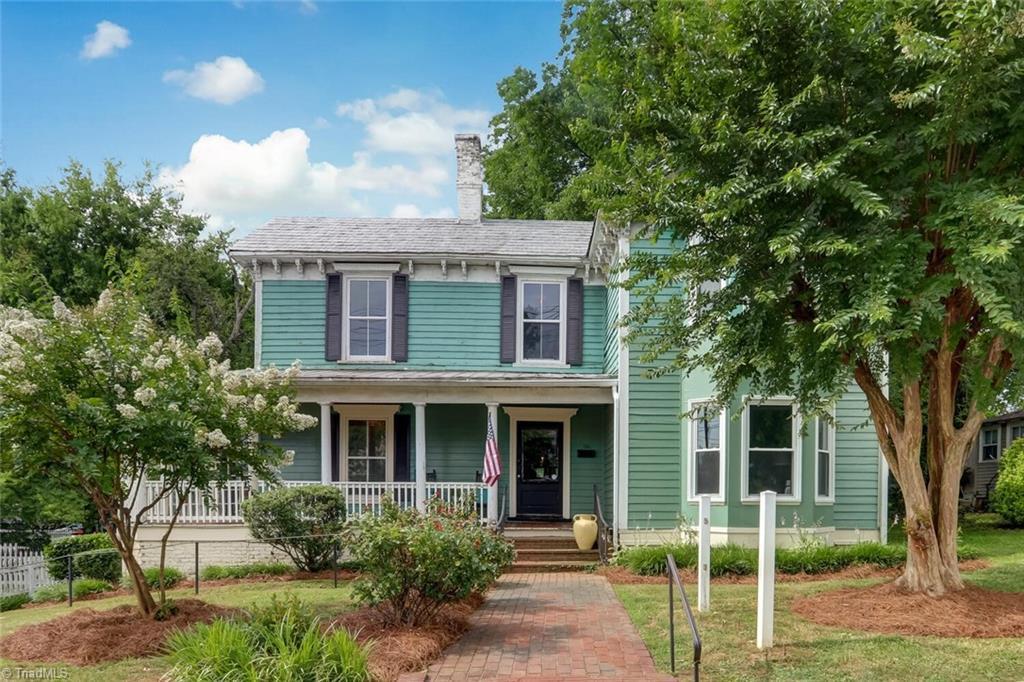
101 W. Academy Street, Madison, Rockingham County
The Pratt-Van Noppen House
- Sold for $180,000 on February 24, 2023 (originally $199,900)
- 3 bedrooms, 2 bathrooms, 2,350 square feet, 0.36 acre
- Price/square foot: $77
- Built in 1890
- Listed July 1, 2022
- Last sale: $200,000, September 2016
- Neighborhood: Academy Street Historic District
- Listing: “Zoned for business and/or residential use.” County tax records describe it as an office building.
- District NRHP nomination: “Two-story frame T-shaped house with two tall interior brick chimneys.
- “Distinguishing features are a two-story, three-sided bay in projecting gabled wing of facade, richly carved pendant brackets all along the roofline, and classical details, including Tuscan porch columns and molded architraves topped by boxed heads above doors and windows.
- “Thomas Ruffin Pratt (1856-1937), prominent local civic and business leader, had the house built during the 1890s. The current [as of 1980] owner is Pratt’s grandson.”
- Thomas and Maybud Julia Pratt (1861-1932) had at least four children. Ownership of the house apparently passed to the eldest, Annie Pearl Pratt Van Noppen (1886-1968). Her husband, John James Van Noppen II (1871-1919), was a first-generation Dutch American and a dentist in Spray. He died in the Spanish Flu pandemic.
- Annie was a teacher and contributed articles to Madison’s newspaper, The Messenger, including a series on historic homes along the Dan River in Rockingham County. After John’s death at age 47, she never remarried and outlived him by 49 years.
- From Thomas’s findagrave.com listing: “Thomas and his brother, Charles Benton Pratt, operated a general merchandise store located in the south half of the Carter-Moir Hardware Store.
- “The two-story building that housed their general merchandise store is located in the Leaksville Commercial Historic District and is included in the National Register of Historic Places. It is a two-story brick building built in the 1880’s and noted for its decorative brickwork. The building may also have housed the Bank of Leaksville, chartered in 1889.
- “In the 1890’s Thomas built a two-story T-shaped house at 101 W. Academy Street noted for richly carved brackets and classical details. Thomas also sold insurance. His other business pursuits included a brick manufacturing plant and a mortuary.
- “He served as a Rockingham County Commissioner and was involved in the infamous story of Rockingham County’s ‘Bridge to Nowhere‘, a bridge built in 1929 across the Dan River with no approaches or connecting roads. Thomas was the chairman of the Rockingham County [Board of Commissioners] when the contract was approved for building the bridge. That resulted in a lengthy and famous lawsuit between the county and the builders, Luten Bridge Company.”
- In an entertaining academic legal paper, the Luten Bridge/Mebane Bridge case is recounted as “a remarkable story, one that arose within a heated tax revolt pitting the county’s farmers against its most celebrated industrialist. Much more than a crisp illustration of the duty to mitigate, Rockingham County v. The Luten Bridge Co. offers a window into a southern community’s struggles with a divided social order, the introduction of wealth into local politics, and a changing economy.”

518 E. Davis Street, Burlington, Alamance County
The John Foster House
- Sold for $230,000 on February 17, 2023 (listed at $250,000)
- The listing says it’s divided into three apartments with five bedrooms and an unspecified number of bathrooms. County records say there are two, so there’s probably one that that was added without a building permit.
- 3,388 square feet, 0.34 acre
- Price/square foot: $68
- Built ca. 1888 (per National Register)
- Listed January 20, 2023
- Last sale: $116,000, May 2000
- Neighborhood: East Davis Street Historic District (NR)
- Note: The listing says, “Needs work”; no interior pictures are included.
- County records date the house to 1910.
- District NR nomination (2000): “A number of late-nineteenth and early twentieth century Queen Anne style houses stand in the district. These are generally two-story frame dwellings with a gable and wing form. The earliest example of this style is the well-preserved John R. Foster House at 518 East Davis Street.
- “Built circa 1888 for John R. Foster of Foster Shoe Company, the house started as three rooms and was enlarged into a twelve room, two-story dwelling with a pressed tin roof, shingle siding in the gable ends and a one-story wraparound porch with a second story balcony over the entrance. Turned posts and balusters, spindle friezes, and sawnwork brackets decorate porch and balcony. …
- “John R. Foster … opened the Foster Shoe Company in the 300 block of Main Street in 1890. The store was one of the first specialty shops in Burlington. The store moved to E. Davis Street after Foster’s death in 1934 and continues to operate there today [as of 2000; it appears to have closed].
- “By at least 1913 the house reached Its present configuration facing E. Davis Street. Upon Foster’s death in 1934, his wife Sallie moved to another house on E. Davis Street and the dwelling was divided into four apartments and rented. In 1935 the house was occupied by Robert Shoffner, clerk of Burlington Mills; Richard Pindell, an overseer; and Robert deFord of Scott’s Billiard Parlor.
- “William A. Patty of Patty Appliances bought the house in 1949 and converted it back to a single family residence. A utility shed and barn which housed a cow, horse and chickens, were originally located at the rear of the property. The barn, which stood on the present lot of 123 Cameron Street, was removed by 1936 when the lot was sold to Faye Simpson. The utility shed was expanded in 1949 to provide a vacuum cleaner repair shop for William Patty.”
- John Foster’s shoe store on a particularly busy day in 1918:

303wgreenway

303 W. Greenway Drive North, Greensboro
The Mary and Hugh Preddy House
- Sold for $915,000 on February 6, 2023 (originally $995,000)
- 3 bedrooms, 3 1/2 bathrooms, 3,961 square feet, 0.61 acre
- Price/square foot: $231
- Built in 1928
- Listed July 14, 2022
- Last sale: $160,000, December 1981
- Neighborhood: Sunset Hills Historic District (NRHP)
- Note: The house is on a hill overlooking Sunset Hills Park.
- Architect Lorenzo Winslow (1892-1976) designed the house. Among his other local works are the Irving Park Apartments on North Elm Street. He later served for 20 years as architect of the White House, responsible for the complete reconstruction of the interior from 1948-52.
- District NRHP nomination: “The two-and-a-half-story, three-bay, side-gabled, brick and half-timbered Tudor Revival-style house features a projecting, two-story, front gable containing the entrance.
- “A wood batten door with metal strap hinges and pierced by a small window with diamond-patterned wood muntins is set in a Tudor arched-head brick surround. Narrow windows with stone sills flank the door.
- “Square posts support a porch that extends along the façade of the south end of the house. It is topped by a wood balustrade enclosing a balcony. French doors replace the original windows and allow access from a second floor bedroom to the balcony. A metal spiral staircase joins the balcony and lower level porch.
- “Windows throughout are primarily casement and six-over-six and four-over-four. A variety of decorative brick patterns grace the first level.
- “On the north elevation, two side-gabled wings of differing heights project from the main block. A one-and-a-half-story, side-gabled wing occupies the south gable end.
- “Two brick chimneys rise from the house, one on the south gable end of the main block and one on the rear roof slope. A wooden Tudor arch crowns a rear recessed entry that is sheathed in weatherboard. A slate roof tops the dwelling.
- “The interior follows a center hall plan with the stair originating in the rear portion of the passage. Just inside the door, the original tile floor remains.
- “The interior remains largely unchanged, except for the removal of a wall between two second floor bedrooms.”
- Hugh Newell Preddy (1886-1952) and Mary Dodson Preddy (1891-1963) bought the house in 1928. Hugh was a clerk for E.A. Pierce & Co., one of the brokerage houses that later were merged into Merrill Lynch, Pierce, Fenner and Smith.
- After the stock market crash, he lost job, and in 1933 the Preddys lost the house to foreclosure. By then, five other family members and a lodger were living with them. The house was bought by the estate of Mary’s grandfather, allowing the family to stay until 1941, when the house was sold.
- The next owners, Wylanta McKay Buckner (1902-1981) and David Buckner (1894-1956), owned the house until 1981, when the current owners bought it. David Buckner was an actuary and later an executive with Jefferson Standard Life Insurance.
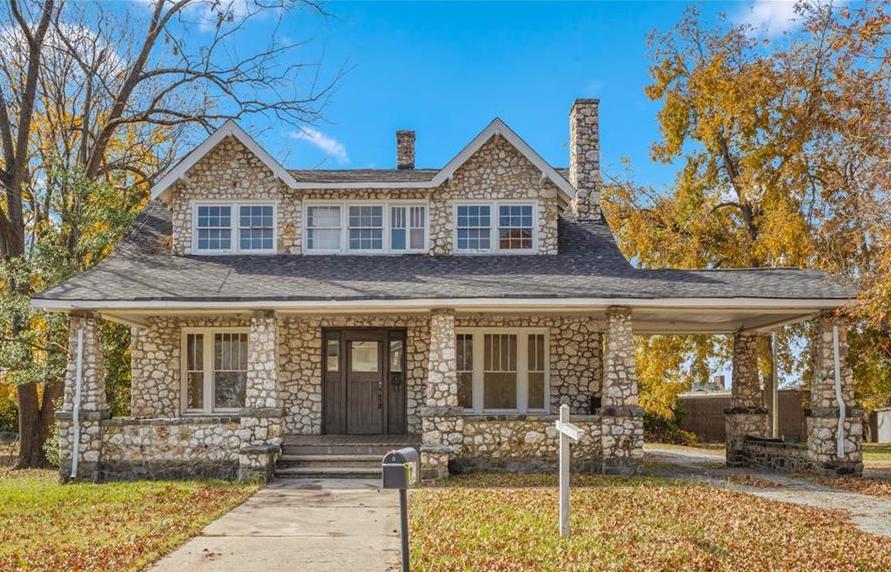
109 Oakwood Street, High Point
The David O. Cecil House
- Sold for $230,000 on February 3, 2023 (listed at $250,000)
- 13 bedrooms, 4 bathrooms, 3,345 square feet, 0.39 acre
- Price/square foot: $69
- Built in 1925
- Listed November 17, 2022
- Last sale: $63,500, August 1994
- Neighborhood: Oakwood Historic District (NRHP)
- Listing: “Has been a Boarding house … During Covid the owners shut it down and planned to remodel but have decided to sell.”
- “Needs cosmetic work such as sheetrock work, painting, and refinishing flooring. … Kitchens and Baths are ready for your renovations.”
- District NRHP nomination: “large bungalow/craftsman house that is very distinctive due to its quartzite stone exterior; gable roof with wide front dormer that is gable front at each end with a shed in between; front porch with massive tapered stone piers extending to porte cochere. Approximately ],670 square feet.
- “The Cecil House is among the finest examples of the bungalow/craftsman style house found in High Point.
- “Cecil was a furniture manufacturer with his plant not far from this home on English. In the 1920s, Cecil started a chain of car service stations and an oil supply company supply them.”


1024 Savannah Lane, Hamptonville, Yadkin County
- Sold for $190,000 on February 2, 2023 (originally $215,000)
- 2 bedrooms, 2 bathrooms, 1,352 square feet, 0.62 acre
- Price/square foot: $141
- Built in 1994
- Listed November 10, 2022
- Last sale: $155,000, June 2020
- Note: Hexagonal house built into an embankment
- The house was sold in 2019 for $18,000.
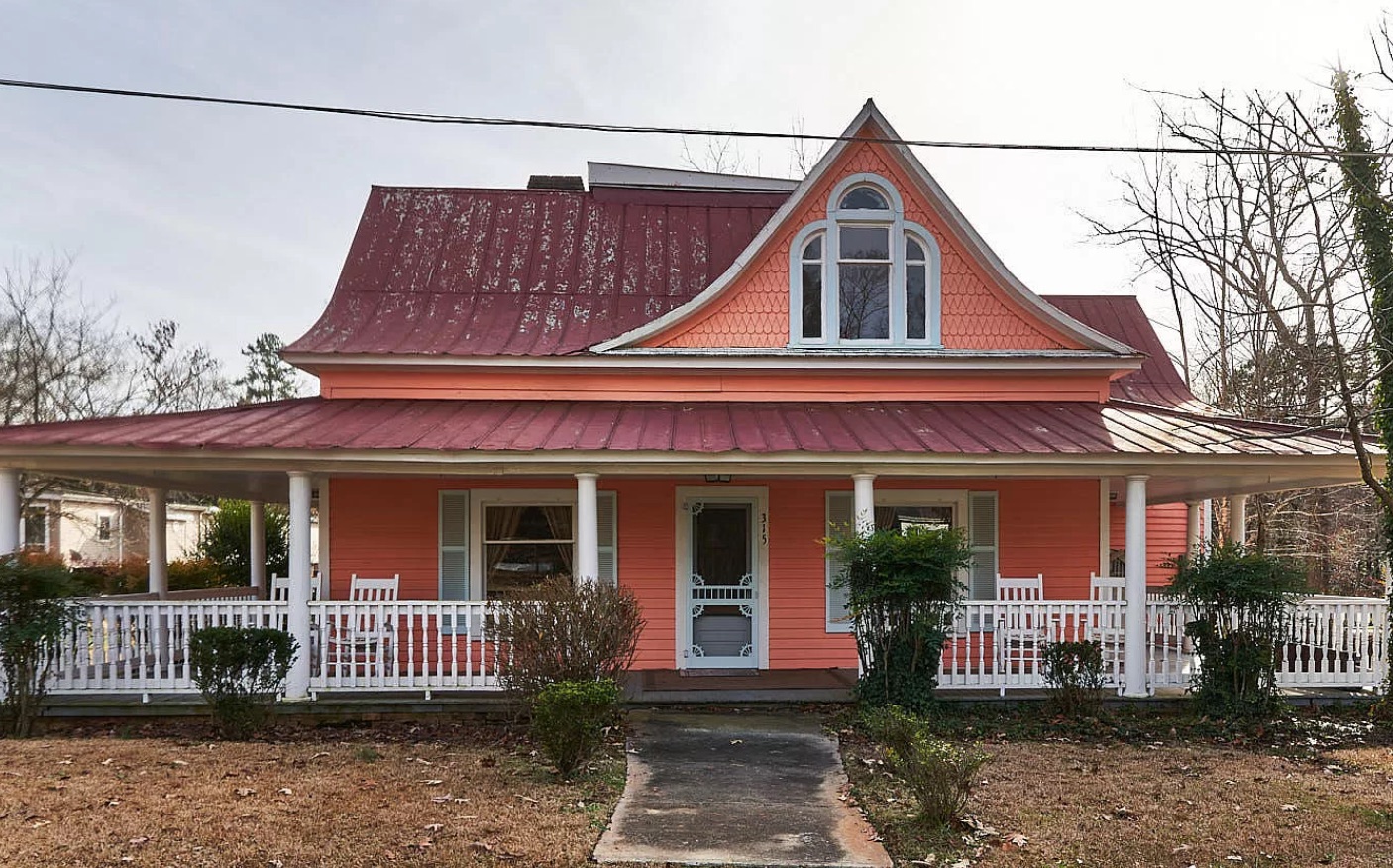
315 Brewer Street, Star, Montgomery County
- Sold for $145,000 on January 18, 2023 (originally $155,000, later $210,000)
- 4 bedrooms, 3 bathrooms, 2,592 square feet
- Price/square foot: $56
- Built in 1892
- Listed December 9, 2019
- Last sale: $125,000, August 2016

7075 Kivette House Road, Gibsonville
The Kivette House
Blog post on Greensboro Historic Homes — The Kivette Houses, Both Now For Sale: The Gibsonville Homes of Two Sisters Who Loved Parties and Elon
- Sold for $900,000 on January 9, 2023 (originally $875,000)
- Closing occurred a year and eight months after the property went under contract
- Bought by a couple whose address is in Thomasville
- 7 bedrooms, 4 1/2 bathrooms, 6,336 square feet, 13.28 acres
- Price/square foot: $142
- Built in 1934
- Listed March 11, 2018
- Last sale: $365,000, December 2004
- Note: The property includes a two-story carriage house.
- The property was marketed previously as a residence or as a b&b/event venue (although there already is one in Gibsonville).
- For more about the colorful Kivette family, click here.
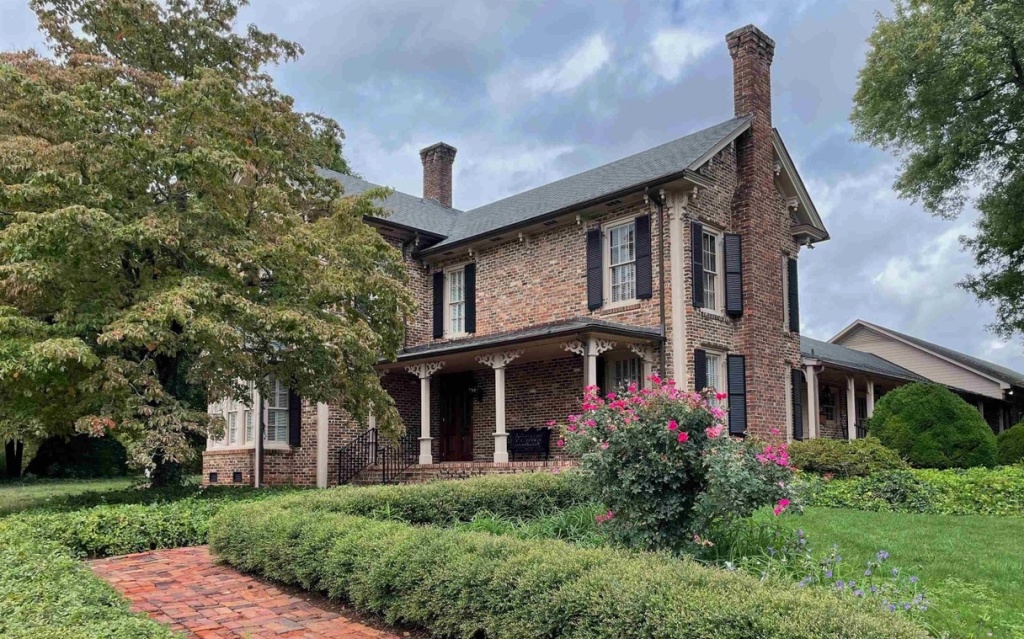
7241 Burlington Road, Whitsett, Guilford County
The Joseph Bason Whitsett House
Blog post — The Joseph Bason Whitsett House: A Possibly Endangered 1883 Guilford County Mansion, $1.3 Million
Update: The house was demolished in June 2023.
- Sold for $3.89 million on January 6, 2023 (27 acres; the listed price was $1.3 million for 11 acres)
- 5 bedrooms, 5 bathrooms, 6,983 square feet, 11.33 acres
- Price/square foot: $557
- Built in 1883
- Listed September 28, 2021
- Last sale: $176,000, October 1987 (11 acres)
- Note: Designated a historic landmark by Guilford County
- The house is now used for offices by a financial firm.
- Listing: The property has three buildings, including a 700 square-foot guest house.
- The house was built by Joseph Bason Whitsett (1835-1917). Joseph was a railroad man, his obituary recalled: “Twenty-five years of his life was [sic] spent in various capacities of railroad work, and he was identified with the first railroad building ever done in this section of the old North Carolina Railroad: afterwards with the Richmond and Danville system, and for a short while with the Southern.” (Greensboro Patriot)
- In 1863, Joseph married Mary Lusetta Foust (1845-1938), whose family owned grist mills and were major landowners in the area.

- Their son, William Thornton Whitsett (1866-1934), was a renowned educator. In 1888, he founded the Whitsett Institute, a boarding school for boys. He operated it until it was destroyed by a fire in 1918. He served on the Guilford County Board of Education for 21 years and as a trustee of the University of North Carolina for 22 years.
- William also was a locally prominent literary figure and historian. The Whitsett Institute published a book of his poems, Saber and Song, in 1917 (now available in hardcover, paperback and Kindle).
- William’s death prompted an especially mournful report in The Burlington Daily Times-News, March 22, 1934:
- “Dr. William Thornton Whitsett has passed away!
- “The sun sank behind the horizon of the life of this illustrious citizen of North Carolina at twelve-forty o’clock last night, following a critical illness of ten days with pneumonia. He was 67 years old. His works will echo and re-echi [typo, probably] throughout many years to come.”
- In addition to the residential listing, the owners have posted a commercial real-estate listing that positions the property for redevelopment, initially referring to the house as “an office building”:
- “Prime development opportunity along the I-40/I-85 corridor in the fast-growing E. Guilford and W. Alamance market. Two properties consist of an office building on 11 acres and a vacant tract of 67 acres. Highest and best use is mixed use residential consisting of apartments, townhomes and SF lots. … Beautiful Victorian House built in the 1880s is currently used as office.”
 Piedmont Historic Homes