


The most impressive historic home sold in the Triad this year may be the 1920’s Tudor Revival mansion in Winston-Salem designed by Charles Barton Keen for Dr. Frederick Moir Hanes and Elizabeth Peck Hanes. It’s definitely the most intriguing. It was a very private sale; the house wasn’t listed publicly. It sold for $1.84 million in April. It hadn’t been for sale since 1972.
Frederick Hanes was one of the most distinguished members of the Hanes family, though he never worked in the family businesses started by his father and uncle. Fred was a highly accomplished physician and teacher and a major figure at Duke in the 1930s and ’40s. He headed the department of medicine at the medical school and was chief physician at Duke Hospital. Betty, a former nurse, was greatly involved with the nursing school. “Betty Hanes was really a great person,” Mary Duke Biddle Trent Semans said.
Fred’s influence at Duke extended beyond the med school. The Sarah P. Duke Gardens were his idea.
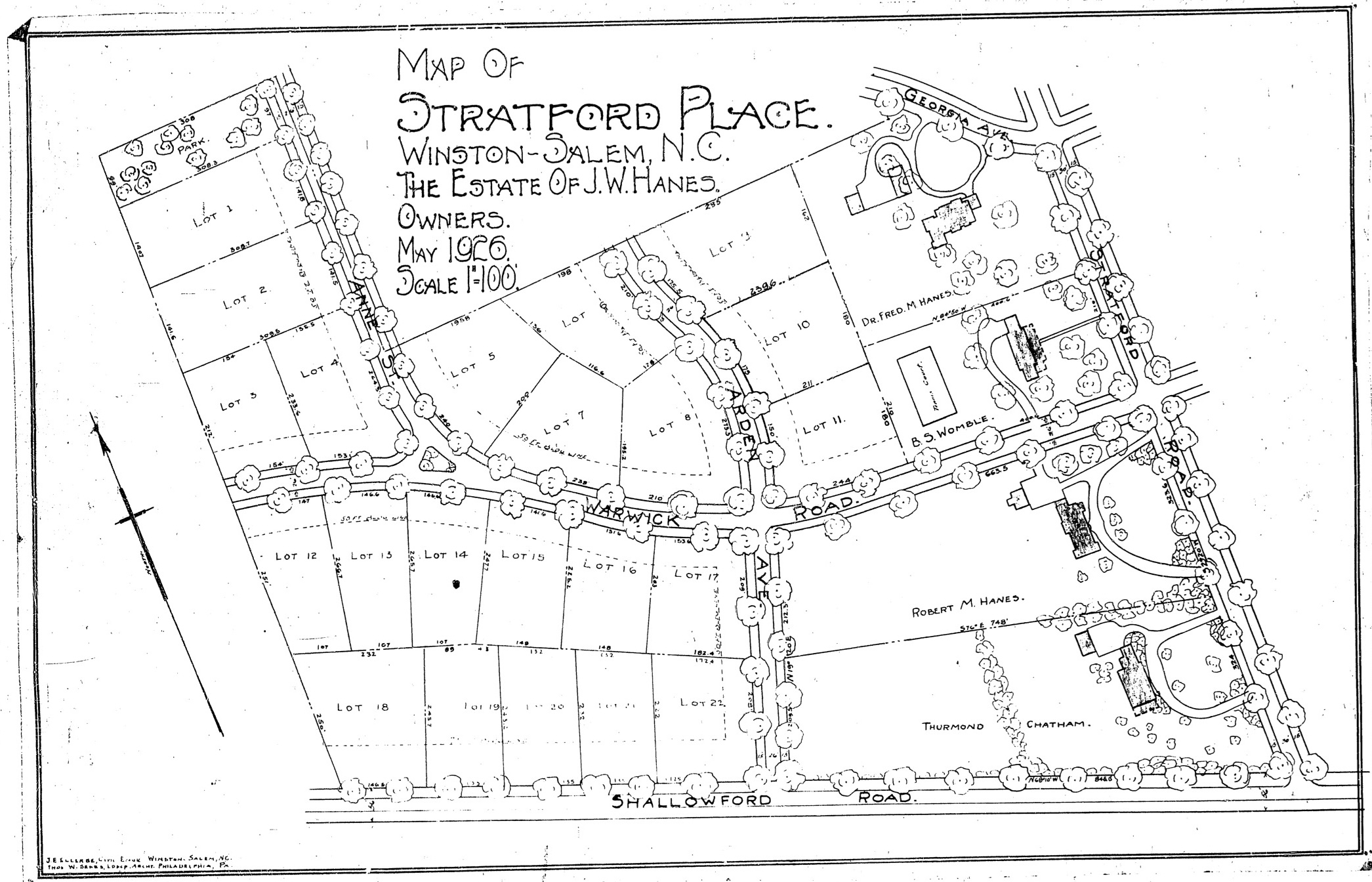
The home is at 226 N. Stratford Road in the West Highlands, specifically the small and exclusive Stratford Place section, which sits on land previously owned by Fred’s father, John Wesley Hanes. Fred and Betty’s house is a block up the street from the home of Fred’s sister, Lucy Hanes Chatham, and her husband, Thurmond Chatham. It’s on the National Register. Also on that block is the home of Robert March Hanes, Fred and Lucy’s brother, also on the National Register. Sharing the block with Fred and Betty’s home is the Bunyan and Edith Womble House (family friends); it’s on the National Register, too. All three houses also were designed by Keen.
A couple of the home’s later owners were quite prominent as well.
‘Olde England’
A recent book on Winston-Salem mansions describes Fred and Betty’s house as “Olde England on Stratford Road” and identifies an “Arts and Crafts aesthetic” within the Tudor design. “The Haneses’ multi-gabled, one-and-a-half story brick Tudor cottage unequivocally evokes the romantic English theme implicit in the naming of Runnyemede Park, Stratford Road and Arden Road.” The cottage is 6,500 square feet.
“Multiple cross gables of varying sizes punctuate the the steeply pitched slate roof, as do massive chimneys crowned by chimney pots. Typical of Winston-Salem country houses of this era were the sleeping porches; less typical were the small closets for a house so large (more than 6,500 square feet). Adjacent to the main house are a Tudor-influenced brick garage and servants quarters …”
We’ll have to take their word for it. The house can hardly be seen from the street, and since it hasn’t been on the market for 52 years, few photos are available apart from those in public records and Google Maps.
Fred and Betty
Dr. Frederick Moir Hanes (1883-1946) and Elizabeth “Betty” Peck Hanes (1883-1953) were listed at 226 N. Stratford Road by 1928. “He was a brilliant physician and scientist, a man of deep principles and unquestioned character, and a natural leader,” a Duke School of Medicine article says.

Fred graduated from the University of North Carolina at age 20, earned a masters at Harvard and received his medical degree from Johns Hopkins. He also studied in Germany and at the Pasteur Institute in Paris. He worked as a pathologist in New York and as a researcher with the Rockefeller Institute. He taught pathology at Columbia University and neurology at Washington University in St. Louis before returning to Winston-Salem to practice medicine. He left to work as a neurologist at a hospital in London and then taught at the Medical College of Virginia. When World War I began, he joined the Army as a lieutenant colonel and served at an Army hospital in France.
He returned to Winston-Salem after the war and resumed his practice. He also served as medical director for Security Life & Trust, of which he eventually became chairman (the company later was known as Integon, then merged with GMAC and now is National General Insurance, a Winston-Salem-based unit of Allstate).
In 1930 Fred left Winston-Salem again, this time for good, to become a founding faculty member at the Duke School of Medicine. He headed the department of medicine, held a distinguished professorship, taught and conducted research.
His most recognizable contribution to Duke came in 1934, when he convinced Sarah P. Duke to finance a garden in an unsightly ravine on campus. A year later, heavy rains washed the vast plantings away, and after Sarah’s death in 1936 he convinced her 16-year-old granddaughter, budding philanthropist Mary Duke Biddle, to create a new garden on higher ground as a memorial. The Sarah P. Duke Gardens now include 55 acres of gardens and woods, 5 miles of walks and paths, and thousands of plants. Almost 500,000 people visit every year.
Frederick and Betty donated the funds to build a dormitory for nursing students, Elizabeth Hanes House. Betty had been a nurse at Johns Hopkins. “Betty Hanes was a very elegant sort of person; rather, I think, in some ways, she was formal, I would say. And Dr. Hanes was formal, too,” Mary Duke Biddle Trent Semans recalled in a 2007 oral history interview. “… I didn’t know her as well as I did him. He took over my mother’s case, so I just, you know, revered him, and my grandmother just adored him. … I felt very in awe of both of them. But Betty Hanes really poured a lot of her life into the nursing school.” The Haneses hosted parties for med school residents and others at their home in one of the mansions on Duke’s Campus Drive.
Fred was only 62 when he died. Betty died eight years later. Frederick left his estate to the School of Medicine. They also donated the books that formed the initial medical school library.
“He was a lover of art, a bibliophile, a horticulturist, and an admirer of Samuel Johnson‘s works,” NCpedia says.
Fred and Betty also were close friends of H.L. Mencken, one of the most significant journalists and social critics of the first half of the 20th century (about 500 letters from Mencken to the Haneses are in the archive at UNC-Chapel Hill; “Mencken’s letters concern mutual friends, travels, Mencken’s visits to the Haneses’ house, politics and public figures, Mencken’s writing, food and drink, the health of Mencken and his wife Sara Haardt Mencken, and other matters.”).
Later Owners
In 1935, the Haneses sold the house to Charles E. Norfleet (1902-1973) and Katy Norwood Norfleet (1905-1976). Charles was an attorney and assistant trust officer at Wachovia. He also served as vice president of the Old Town Country Club. Charles spent his career at Wachovia, retiring as a vice president. Banking ran in the family; his uncle, Charles M. Norfleet, was president of First National Bank of Winston-Salem. Charles E. also served as chairman of the board of Goody’s Manufacturing and as a member of the county planning board.
Charles E.’s greatest impact on the community came as a member of city’s airport commission. “Mr. Norfleet has been credited with almost single-handedly building Smith Reynolds Airport and acquiring airline service here,” the Winston-Salem Journal said in his obituary.
“At the time he became a member of the Airport Commission, the airport was a 100-acre field converted from the county farm over the protests of a county official who complained that ‘this is the best corn-growing land around here.’” The airport’s address is now 3800 Norfleet Drive.
The Norfleets sold the house in 1961 to Philip Michalove (1916-2010) and June Michalove (1924-2017). Philip was president of the State Furniture Company; June was secretary-treasurer. They owned the house for 11 years.
They sold the house in 1972 to Robert L. Strickland (1931-2018) and Elizabeth Miller Strickland (1932-2023). Their children just sold the house. Robert was born in Florence, South Carolina, and grew up in Asheboro. He graduated from UNC-Chapel Hill and served in the Navy during the Korean War. After graduating from Harvard Business School, he joined Lowe’s Companies in 1957 as advertising director. He retired 40 years later as chairman of the board. He served a single term in the state House, elected in 1962. He later served on the boards of the School of the Arts Foundation, Wilkes Community College and UNC-CH, of which he was chairman for two years. He served on the board of the Federal Reserve Bank of Richmond and the corporate boards of T. Rowe Price, Hannaford Brothers and Krispy Kreme.
Elizabeth grew up in several states, including North Carolina, as her father was a naval officer. She attended High Point College. In the 1980s she opened Oxford Antiques and Gifts, a philanthropic venture that generated more than $1 million for the Crisis Control Ministry, the North Carolina Shakespeare Festival, the Winston-Salem Symphony and other nonprofits.
The Stricklands’ children sold the house in April to an LLC in Charlotte associated with a CPA and business consultant who provides “strategic leadership” services to families burdened with “the practical and emotional complexities of legacy wealth.”

226 N. Stratford Road, Winston-Salem
The Hanes-Norfleet-Strickland House
- Sold for $1.84 million on April 9, 2024
- 5 bedrooms, 3 1/2 bathrooms, 6,591 square feet (house), 7,273 square feet (total), 2.85 acres
- Price/square foot: $253
- Built in 1925 (per county)
- Not listed publicly for sale
- Last sale: $200,000, August 1972
- Neighborhood: Stratford Place, West Highlands
 Piedmont Historic Homes
wow!! 202 Extraordinary Restoration Opportunities
LikeLike